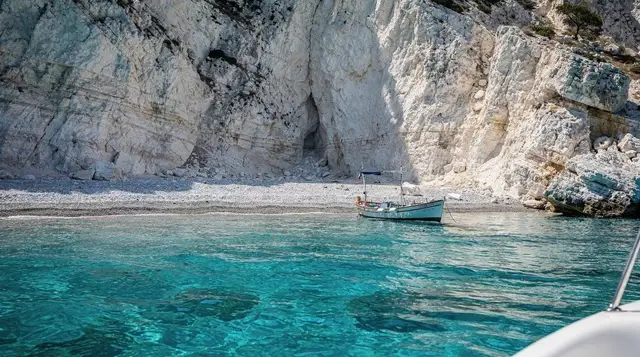
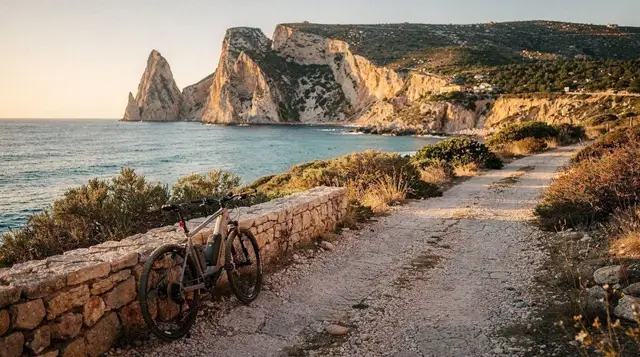
Most visitors reach Ogliastra for the coast — Cala Goloritzé, the cliffs around Baunei, the beaches near Arbatax — and never climb the winding road inland to Ulassai. That’s understandable, but it means they miss one of the best show caves in Europe, a serious inland climbing scene, and a small museum built around one of Sardinia’s most interesting 20th-century artists. Ulassai is a village of around 1,300 people perched on the edge of the Tacchi d’Ogliastra, the limestone “heel” plateaux that give this part of the island its dramatic, dry, un-Mediterranean-looking terrain.
This is not a beach town and it never pretends to be one. There’s no sea here, no promenade, no seafood restaurants lined up for tourists. What Ulassai has is Su Marmuri, one of the largest cave systems open to the public anywhere in Europe; a genuinely respected sport-climbing and via ferrata destination on its limestone crags; and the Stazione dell’Arte, a small but serious museum dedicated to Maria Lai, the land artist who was born here in 1919. Treat it as a detour from Ogliastra’s coast, not a replacement for it.
Ulassai at a glance
| Where | Inland Ogliastra, on the edge of the Tacchi d’Ogliastra plateaux, east-central Sardinia |
| Distance from the coast | About 24 km from Arbatax, roughly 45–55 minutes by car on narrow, winding roads |
| Su Marmuri visit length | Guided tour, typically 60–75 minutes |
| Su Marmuri entry fee | Check current opening times and the entry fee, typically in the €12–18 range for adults |
| Getting there | Car only; no useful public transport link for a day trip |
| Best time to visit | April–June and September–October for cooler hiking and climbing conditions |
| Days needed | 1 day for the cave and village; 2 if combined with climbing or hiking |
Getting to Ulassai
There’s no way around it: the road up to Ulassai from the coast is slow. From Arbatax or Tortolì it’s around 24 km, but the SS198 climbs steadily through switchbacks into the hills, and a realistic driving time is 45 to 55 minutes rather than the 20 minutes the distance alone would suggest. There’s no motorway shortcut — this is single-carriageway mountain road the whole way, occasionally down to one lane where it passes through rock cuttings. Budget for it rather than trying to squeeze Ulassai into a rushed afternoon after the beach.
Public transport exists on paper (ARST regional buses do serve Ulassai from Lanusei and occasionally Tortolì) but schedules are thin, often geared to school and market days, and unworkable for a same-day round trip if you want to see the cave and walk anywhere. A hire car is effectively mandatory, as it is for most of inland Sardinia — see renting a car in Sardinia and driving in Sardinia if you haven’t sorted one yet. If you’d rather not drive the mountain roads yourself, a guided jeep excursion up from the coast is a reasonable alternative and usually bundles in a stop at a shepherd’s hut for lunch:
Barbagia and Ogliastra jeep tour with shepherd’s lunch from ArbataxSu Marmuri: one of Europe’s great show caves
Su Marmuri is the reason most people who do make the trip to Ulassai come here. It’s among the largest cave systems in Europe open for guided visits, with a main chamber tall and wide enough that photographs consistently undersell it — you need to stand under it to register the scale. The name comes from the marble-like sheen of some of the flowstone formations, built up over hundreds of thousands of years of mineral-rich water dripping through limestone.
Visits run as fixed-schedule guided tours, walking a paved path through the accessible sections with lighting installed to pick out stalactites, stalagmites and larger formations without over-lighting the space. A standard tour takes roughly an hour to 75 minutes. The cave sits at a stable, cool temperature year-round, which makes it a genuinely good option on a hot August day when the coast is baking — bring a light layer even in summer, since it’s noticeably cooler underground. Check current opening times and the entry fee directly before you go, since both shift by season; expect something in the €12–18 range for an adult ticket as a rough planning figure rather than a quote.
For context on how Su Marmuri compares with Sardinia’s other show caves — Neptune’s Grotto near Alghero, the Bue Marino cave at Cala Gonone, Is Zuddas in the southwest — see the best caves in Sardinia. Su Marmuri is consistently rated among the most impressive for sheer chamber size, even if Neptune’s Grotto has the more dramatic sea-cliff approach.
Climbing and via ferrata on the Tacchi
Ulassai’s limestone crags have been a fixture of Italian sport climbing since the 1980s, and the village still markets itself, quietly, as a climbing destination first and a tourist stop second. The rock is compact, well-bolted limestone typical of the Tacchi d’Ogliastra, with routes ranging from easy multi-pitch introductions to hard, technical sport lines that draw climbers from mainland Italy and further afield. Some of the historic routes here are locally protected as part of Sardinia’s climbing heritage, which says something about how long this has been a serious destination rather than a recent addition to guidebooks.
Via ferrata routes are also present in the area, giving a way to experience the exposure of the Tacchi’s limestone walls with fixed cables and rungs rather than a rope and rack. For a broader picture of where Ulassai fits among Sardinia’s climbing areas, see rock climbing in Sardinia and via ferrata in Sardinia — both cover route grading, gear norms, and other crags worth cross-referencing, including areas around Baunei and the wider Supramonte.
| Level | What to expect around Ulassai |
|---|---|
| Beginner | Short, well-bolted single-pitch sport routes; guided via ferrata sections with cable and rungs |
| Intermediate | Multi-pitch limestone routes, moderate exposure, requires prior sport-climbing experience |
| Advanced | Technical, historic routes on steep limestone faces; local knowledge or a guide strongly recommended |
If you’d rather explore the Golgo plateau and the wider Baunei-Ulassai hinterland on foot with a guide than rope up on a crag, a guided trek toward Cala Goloritzé from the Golgo side covers similar terrain — dry limestone plateau, sinkholes, shepherds’ land — without requiring climbing skills:
Guided trekking tour to Cala Goloritzé from the Golgo plateauWalking the Tacchi d’Ogliastra
Beyond the crags, the Tacchi d’Ogliastra reward simple walking too. These are flat-topped limestone plateaux, geologically related to the Supramonte massif further north, cut by deep gorges and dotted with sinkholes, dry-stone shepherds’ huts (pinnettas) and scrub vegetation that smells of wild rosemary and myrtle in early summer. Marked paths around Ulassai range from easy loops of an hour or two to longer half-day routes that connect toward neighbouring villages.
For hikers planning a longer stay in the area, this pairs naturally with routes covered in hiking in Sardinia, and with more demanding options like the Selvaggio Blu trek or the hike to Cala Goloritzé, both of which start from villages within striking distance of Ulassai. If you’re building a full week around hiking rather than beaches, the Sardinia hiking 7 days itinerary is a useful starting template to adapt.
Maria Lai and the Stazione dell’Arte
Ulassai’s other claim to fame has nothing to do with rock. Maria Lai, born here in 1919, became one of Italy’s more quietly influential 20th-century artists, working across textile art, land art and installation. Her best-known public work, Legarsi alla montagna (“Tying oneself to the mountain”), physically connected the houses of Ulassai to the surrounding hillside with kilometres of blue ribbon in 1981 — a piece still referenced in Sardinian art history and visible in traces around the village today.
The Stazione dell’Arte, a converted former railway station turned small museum, holds a permanent collection of her work alongside temporary exhibitions. It’s modest in scale compared with a major city gallery, but genuinely worth 45 minutes to an hour if you have any interest in contemporary art or in understanding why a village this size has such a disproportionate cultural footprint. It sits comfortably alongside other cultural stops covered in museums worth visiting in Sardinia.
Where Ulassai fits on a longer trip
Most visitors combine Ulassai with a base on the coast rather than sleeping here. Arbatax and Tortolì are the obvious bases, both under an hour away and well set up with hotels and restaurants geared to summer visitors. From either, Ulassai works as a half-day trip focused on the cave, or a full day if you add a climbing session or a walk on the Tacchi.
If you’re building a longer inland loop, Ulassai pairs naturally with other Barbagia and Ogliastra villages known for murals, crafts and mountain culture — Orgosolo and Mamoiada further north, or Oliena and Dorgali on the edge of the Supramonte. For travellers spending a full week on the eastern side of the island, the east coast Sardinia 7 days itinerary can absorb a Ulassai detour without derailing a beach-focused schedule, and it’s an easy add-on if you’re already heading toward the Gennargentu massif for its higher peaks and cooler air.
Frequently asked questions about visiting Ulassai
Do I need to book Su Marmuri in advance?
It’s sensible to during July and August, or around Italian public holidays, when guided slots can fill up. Outside peak season you can often turn up and join the next scheduled tour, but checking ahead in any case avoids arriving between tour times with a long wait.
Can I visit Ulassai without a car?
Not comfortably. ARST buses do reach the village on a limited timetable, but the frequency isn’t built for a same-day round trip that also allows time for the cave and a walk. A hire car, or a guided jeep tour from the coast, is the realistic option for most visitors.
Is Su Marmuri suitable for young children or anyone with mobility issues?
The main tour route is paved and lit, which helps, but there are steps and some uneven sections typical of a working cave rather than a purpose-built visitor attraction. It’s manageable for most reasonably fit children on a guided walking pace; check directly with the cave operator if mobility is a specific concern.
How does Ulassai compare with the Supramonte caves near Dorgali?
Su Marmuri is generally rated among the largest and most visually dramatic show caves on the island, on a similar tier to the Bue Marino cave near Cala Gonone. The Supramonte caves lean more toward boat access and coastal scenery around the approach; Ulassai’s cave is a purely inland, mountain-village experience.
Do I need climbing experience to enjoy a visit here?
No. Su Marmuri, the Stazione dell’Arte and simple walks on the Tacchi require no climbing background at all. The sport-climbing and via ferrata routes are there for people who want them, but they’re a bonus layer on top of a village that works fine as a cultural and caving day trip.
What’s the best time of year to visit Ulassai?
Spring (April to June) and early autumn (September–October) give the most comfortable conditions for the approach walks, the climbing routes and general wandering around the village, since inland Ogliastra gets genuinely hot in July and August. The cave itself stays cool year-round, so it’s a viable stop even in high summer if you’re sheltering from the heat.
Is there anywhere good to eat in Ulassai itself?
Options are limited compared with the coast, but there are a handful of trattorias and agriturismi in and around the village serving solid Barbagia-Ogliastra cooking — roast meats, hearty pasta, local cheeses. Don’t expect the range or polish of restaurants in Arbatax or Tortolì; this is simple mountain food, generally good value.