Driving in Sardinia
What is driving in Sardinia actually like?
Slower than the map suggests. There's no motorway outside the SS131 dual carriageway linking Cagliari, Oristano and Sassari, and the real average driving speed on most other roads is closer to 60km/h once you account for coastal bends, single-lane village streets and mountain switchbacks. Distances that look short on a map routinely take twice as long as a straight-line estimate implies.
The map lies about how long everything takes
Sardinia looks compact on a map — roughly 270km from north to south — and that scale fools a lot of first-time visitors into planning driving days the way they would on a mainland European motorway network. The island doesn’t have one. The only genuine dual carriageway is the SS131 “Carlo Felice”, running Cagliari-Oristano-Sassari-Porto Torres with a branch (SS131DCN) to Nuoro, and outside that single corridor, real average driving speeds drop to somewhere around 60km/h once coastal bends, village high streets and mountain switchbacks are factored in.
Cagliari to the Gulf of Orosei, around 140km as the crow flies, routinely takes 2.5 to 3 hours. Budget by drive time, not distance — see our driving times reality check for specific route timings.
| Only true dual carriageway | SS131, Cagliari-Oristano-Sassari, plus the SS131DCN branch to Nuoro |
| Realistic average speed elsewhere | Around 60km/h once bends, villages and terrain are factored in |
| Urban speed limit | 50km/h (often lower near schools) |
| Extra-urban limit (most roads) | 90km/h, rarely achievable on coastal or mountain routes |
| SS131 limit | 110km/h on the dual carriageway sections |
| Fuel | Petrol and diesel both widely available; rural stations often close Sunday afternoons |
Roads that aren’t what the road type suggests
A numbered “SS” (Strada Statale) road in Sardinia can mean anything from a fast, well-surfaced two-lane route to a narrow, unmarked mountain lane with no shoulder, and the difference isn’t always obvious from a map or GPS route. The SS125 Orientale Sarda, running the length of the east coast, is the clearest example: a vital connecting road with genuinely spectacular scenery through the Gulf of Orosei’s hinterland, but slow, winding, and demanding proper attention rather than the cruising pace its “main road” status implies. Interior routes through the Gennargentu and Barbagia are similar — beautiful, but not roads to plan a tight schedule around.
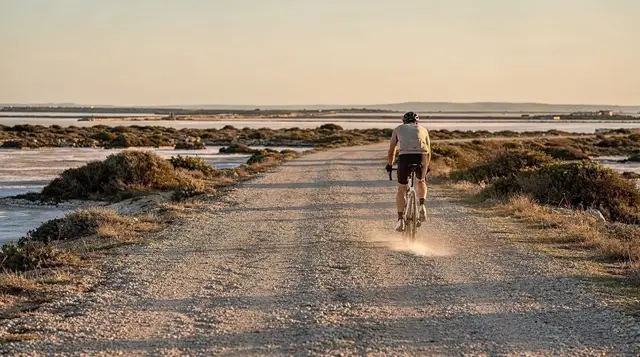
Beyond the numbered network, reaching many of Sardinia’s best beaches means the final stretch runs on a strada bianca — an unpaved, graded gravel or dirt access road, common right across the island rather than a rare exception. Most are perfectly manageable in an ordinary rental car at low speed, but they’re not roads to take at speed regardless of how empty they look, and after heavy rain a handful can develop ruts worth approaching cautiously.
Fuel, stations and what catches visitors out
Petrol (benzina) and diesel (gasolio) are both widely available, and self-service pumps (fai da te) are standard and generally cheaper than attended service (servito) at the same station — look for the button or screen prompt before assuming you need to wait for an attendant. Rural stations, especially away from the main towns, frequently close on Sunday afternoons and sometimes for a long lunch break, which matters more in the interior than on the coast. Confirm your rental car’s fuel type before leaving the agency — mixing them up is a real and costly mistake, and rental fleets run a genuine mix of both.
Roundabouts, livestock and rural driving habits
Roundabouts are the default junction type across the island, far more common than traffic lights outside the main towns, and Sardinian drivers generally treat them efficiently once you’re used to yielding to traffic already on the roundabout. The bigger adjustment for visitors from countries with fenced farmland is livestock on the road: sheep, goats and occasionally cattle cross or graze along unfenced stretches of interior road, particularly in the Barbagia and Gennargentu areas, and a slow, cautious approach around blind bends in rural zones is worth the habit — animals don’t reliably move for a car’s approach.
Parking, ZTL zones and town centres
Blue-lined parking spaces (strisce blu) require payment, typically via a roadside meter or an app, and are common in every town centre in peak season; white lines are free. Historic centres in Alghero, Cagliari’s Castello quarter and Olbia carry ZTL (Zona a Traffico Limitato) restricted zones where camera-enforced fines apply to unauthorised entry — our renting a car in Sardinia guide covers how these fines get issued and why parking outside the zone and walking in is the simpler choice almost everywhere.
Tolls, insurance and what a rental agency will and won’t tell you
Sardinia’s roads carry no tolls anywhere on the island — the SS131 and all other state and provincial roads are free to use, a detail worth knowing since some visitors coming from mainland Italy’s motorway network expect a toll booth that never appears. Rental agencies almost universally include third-party liability by law, but collision damage waivers vary enormously in what they actually cover; a genuinely full waiver with no excess is worth paying for on rural roads with narrow verges and the occasional stray animal, since a minor scrape against a dry-stone wall on a single-track village street is a realistic scenario rather than a remote one.
Read the excess amount specifically before signing — it’s often buried lower in the contract than the headline daily rate suggests, and a low advertised price with a high excess can end up costing more than a slightly pricier option with better cover.
Speed cameras, fines and how enforcement actually works
Fixed and mobile speed cameras operate across the island, more densely on the SS131 and around town approaches than on quiet interior roads, and Italy’s system issues fines to the rental company, which then passes the charge — plus an administrative fee — on to the card used for the booking, sometimes weeks or months after the trip ends. ZTL camera fines work the same way and catch out more visitors than speed cameras do, since a restricted zone entry isn’t always obviously signed to someone unfamiliar with the small white-on-red ZTL circle.
There’s no way to talk your way out of either after the fact; the practical defence is simply driving cautiously in town centres and treating any electronic sign showing a speed limit as a camera-enforced one rather than a suggestion, since Sardinian traffic police do enforce the posted limits, particularly around Cagliari, Olbia and Alghero.
SS131 vs the rest of the network
| SS131 (Cagliari-Sassari) | Everywhere else | |
|---|---|---|
| Surface | Excellent, dual carriageway | Good to average, single carriageway |
| Speed limit | 110km/h | 90km/h extra-urban, rarely achievable |
| Realistic average | 90-100km/h | Around 60km/h |
| Overtaking | Straightforward, marked lanes | Difficult on coastal bends, generally discouraged |
| Character | Fast, functional, few views | Slower but where the scenery actually is |
Treat the SS131 as the transport spine connecting the island’s three airport regions, and everywhere else as the part of the trip where the drive itself is part of the experience rather than a means to an end.
Night driving and what changes after dark
Interior and coastal roads outside the SS131 have minimal lighting once you’re away from town centres, and the livestock risk covered above becomes noticeably harder to manage after dark, since an animal on the road is far less visible against unlit tarmac than in daylight. Headlight use is compulsory on all roads outside built-up areas even during the day in Italy, not just at night, a rule that catches out visitors used to daytime running lights being optional.
If a long evening drive is unavoidable — arriving late into Olbia or Alghero from the airport, for instance, or returning from a Dorgali dinner to a Cagliari base — reducing speed further below the daytime average is the sensible adjustment, and a transfer or overnight stay closer to the destination is worth considering over a long night drive on unfamiliar mountain roads.
Motorbikes, cyclists and sharing narrow roads
Summer brings a genuine number of cyclists onto Sardinia’s coastal and interior roads, drawn by exactly the scenery that makes the driving slow, and motorbikes and scooters are common in and around every town. Sardinian drivers generally give cyclists a wide, patient berth on narrow roads, and visitors are well advised to match that habit rather than push an overtake on a blind bend — the same single-lane village streets and mountain switchbacks that slow down cars are considerably more dangerous to get wrong around a cyclist.
Scooters in town centres, particularly Cagliari and Alghero, weave through traffic in ways that take some adjustment for visitors used to more rigid lane discipline, so extra mirror checks before turning or changing lanes in urban areas are worth the habit.
Car seats, child restraints and family driving
Italian law requires appropriate child car seats for children under 150cm in height, and rental agencies across Sardinia stock them, but availability for infant seats specifically can run short in the busiest weeks of July and August, so booking a seat at the same time as the car rather than assuming one will be available on arrival is the safer approach. Confirm the seat’s age and weight category matches your child specifically when booking, since agencies don’t always stock every size, and a mismatched seat is both against the law and less safe than it looks.
When driving isn’t worth it: transfers instead of the wheel
Not every leg of a Sardinia trip needs to be self-driven, particularly the airport-to-hotel run at the start and end of a stay, when jet lag or a late flight makes navigating an unfamiliar road network the last thing you want. If you’re heading to the Costa Smeralda area, the Porto Cervo airport transfer in business class and the equivalent Porto Cervo airport transfer in economy class both cover the run from Olbia airport without needing to collect a rental car the moment you land.
Further along the east coast, the Olbia Airport transfer to Orosei and Cala Ginepro covers a genuinely long, winding drive — over an hour each way on the SS125 — with a driver rather than a first-time navigation of that road straight off a flight.
Within Alghero, the private transfer to and from Alghero-Fertilia Airport covers a short but easy-to-mishandle first drive for anyone not used to Italian roundabout etiquette on arrival. And for visitors basing themselves centrally in Cagliari rather than covering the whole island, the bike rental covering Cagliari’s port, Su Siccu and Molentargius replaces a rental car entirely for a city-based stay, avoiding the parking and ZTL complications a car brings into a town that’s genuinely walkable and cyclable.
Building drive times into an itinerary
Because real driving speeds run well below what a straight-line distance suggests, itinerary planning in Sardinia benefits from anchoring around a small number of bases rather than a different town each night. Our how many days do you need in Sardinia guide and the itineraries section both build routes around this reality, and driving times reality check has specific timings between the island’s most-visited towns.
For the rental logistics behind all of this, see renting a car in Sardinia, and for visitors who’d rather skip driving altogether, visiting Sardinia without a car and public transport in Sardinia lay out what’s realistically achievable instead.
Frequently asked questions about driving in Sardinia
Is there a motorway in Sardinia?
Not in the strict sense. The SS131 and its SS131DCN branch are dual carriageways (“superstrada”) linking Cagliari, Oristano, Sassari and Nuoro with no tolls, but there is no true autostrada anywhere on the island.
What’s a realistic average driving speed to plan around?
Around 60km/h on most roads outside the SS131, once coastal bends, village streets and mountain terrain are factored in — noticeably slower than mainland motorway driving.
Are unpaved roads to beaches safe for an ordinary rental car?
Generally yes at low speed and in dry conditions; most stradas bianche are graded gravel manageable in a standard car. Approach with more caution after heavy rain, when ruts can develop.
Do I need to worry about livestock on the roads?
In rural and interior areas, yes — sheep, goats and occasionally cattle cross or graze on unfenced stretches, particularly in the Barbagia and Gennargentu. Slow down around blind bends in these zones.
What should I know about fuel stations in rural Sardinia?
Many close on Sunday afternoons and for extended lunch breaks, especially away from main towns. Self-service pumps are usually cheaper than attended service at the same station.
Is it worth avoiding driving altogether and using transfers instead?
For a city-based stay in Cagliari, Alghero or Olbia, yes — a car becomes a parking and ZTL headache rather than a convenience. For any itinerary covering beaches, hiking or multiple regions, a car remains the more practical choice overall, with transfers filling in for the trickiest individual legs.
Are there tolls on Sardinian roads?
No — the SS131 and every other road on the island are toll-free.
What happens if I get a speed or ZTL camera fine after returning the rental car?
The fine goes to the rental company first, which then charges your card on file, usually with an added administrative fee, sometimes weeks after the trip. There’s no way to contest it after the fact from abroad in practice, so the fine simply has to be paid.
Transport passes & transfers on GetYourGuide
Verified deep-linked GetYourGuide tours. Book through these links and we earn a small commission at no cost to you.
These are our own photographs of Sardinia, not the operator's pictures of this tour — open the tour page to see those.