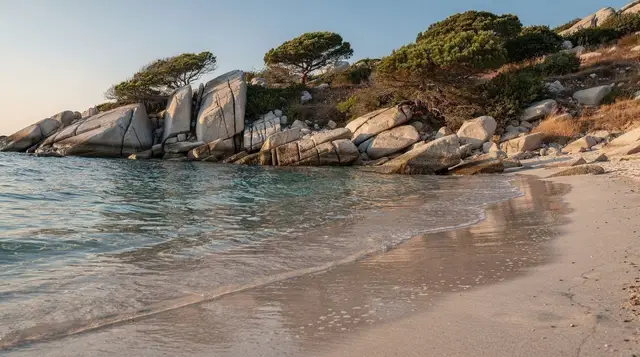
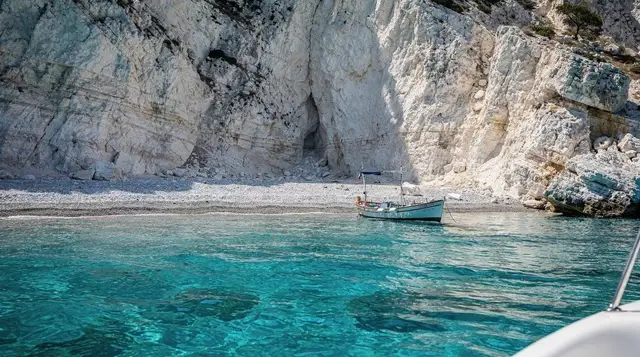
Cala Mariolu, the marbled-pebble beach of the Gulf of Orosei
How do you get to Cala Mariolu?
By boat from Cala Gonone, Santa Maria Navarrese or Arbatax, or on foot via a demanding 3-4 hour hike from the Genna Silana pass that includes a chained rock-face descent. There's no road and no realistic day-trip option that skips one of the two.
Cala Mariolu sits halfway down the Gulf of Orosei’s limestone coastline, in the municipality of Baunei, and it’s the beach most people mean when they say a Sardinian cove looks “too blue to be real.” The pebbles are the reason: small, rounded, and marbled in white, pink and grey, they sit under water so clear that the seabed is visible well past swimming depth. There’s no village, no road, and — outside a handful of fishermen’s huts long since abandoned — no permanent structure of any kind.
| Where | Gulf of Orosei, Baunei municipality, between Cala Goloritzé and Cala Sisine |
| Cost | Free to visit; boat transport €35-60pp, hike is free but requires fitness |
| Time needed | Half a day minimum if arriving by boat, a full day for the hike |
| Getting there | Boat only, or a 3-4 hour round-trip hike from Genna Silana |
| Best time | June to September for swimming; May and October for the hike without summer heat |
No road ever reached this coast, and that’s the whole appeal
The Gulf of Orosei’s cliffs rise almost straight out of the sea for over 40km, and the coastal road that serves the rest of Sardinia simply stops at Cala Gonone in the north and Santa Maria Navarrese in the south. Everything between — Cala Luna, Cala Sisine, Cala Mariolu, Cala Goloritzé — is reachable only by boat or on foot, which has kept the coastline free of the beach clubs and car parks that crowd more accessible parts of the island. It’s also why a visit here needs more planning than a beach you can simply drive to.
Getting there by boat
Boat is the easier option and the one most visitors choose. Excursions run from Cala Gonone, Santa Maria Navarrese and Arbatax, typically as full-day trips that combine Cala Mariolu with Cala Goloritzé, Cala Sisine or Cala Luna depending on the operator and the sea state.
Expect to pay roughly €35-60 per person for a shared boat with several stops, or considerably more for a private charter or a rental dinghy if you hold (or hire with a skipper) the right licence — see renting a boat without a licence in Sardinia for what’s actually allowed. A cruise along the Baunei coast from Santa Maria Navarrese covers this stretch with swim stops built in:
Baunei coast cruise with swim stops from Santa Maria NavarreseFrom further south, a full-day guided boat tour departing Arbatax works the same coastline from the opposite direction, useful if you’re based around Tortolì or Ogliastra rather than up near Dorgali:
Full-day guided boat tour of the Baunei coast from ArbataxGetting there on foot
The hiking route to Cala Mariolu starts near the Genna Silana pass on the SS125, the same trailhead used for several routes into the Supramonte and Golfo di Orosei hiking network covered in the Supramonte hiking guide. It’s a genuinely demanding walk: roughly 3-4 hours round trip, with a steep, exposed final descent that uses fixed chains bolted into the rock face to help hikers down the last stretch to the beach. Good footwear is not optional here — trainers are a common cause of turned ankles on the loose limestone scree.
Anyone who wants to combine the hike with the neighbouring, even more photographed cove can look at a guided version that covers both in one outing:
Guided Cala Goloritzè trekking tour from BauneiFor the specific route notes to that adjacent beach, the hike to Cala Goloritzè and the Cala Goloritzè guide cover the trailhead, the chains, and the two beaches’ very different access rules in more detail.
The access situation and what it costs
Cala Mariolu falls inside the protected coastal strip managed jointly by the Baunei municipality and the regional forestry service, and in recent seasons that’s meant a light-touch access limit during July and August: a daily cap on the number of hikers allowed down the chained descent at any one time, plus a small contribution (typically a few euros) that goes toward trail maintenance.
It’s nowhere near as strict as the reservation system at Cala Goloritzè — there’s no need to book online months ahead — but arriving at the trailhead by mid-morning in peak season avoids any queue at the top of the descent. Numbers and fees reset each year, so check the current Baunei municipality notices before you go; see Sardinia’s beach access quotas for how Mariolu compares with La Pelosa, Goloritzè, Cala Brandinchi and Tuerredda.
What the beach is actually like once you’re there
Cala Mariolu is short — a few hundred metres of pebble backed directly by cliff — and it fills up by late morning in August when several boats converge at once. The water drops off quickly a short way from shore, which locals and returning visitors both rate as the best swimming and snorkelling of the whole gulf: visibility regularly exceeds 15-20 metres in calm conditions. There’s a small freshwater spring near the northern end that seeps out of the rock, one of the few natural water sources on this stretch of coast, though it’s not reliable enough to depend on for drinking.
Snorkelling and the underwater landscape
The same clarity that makes Cala Mariolu’s pebbles glow also makes it one of the better snorkelling spots on the entire Gulf of Orosei. The seabed drops in shelves rather than a single steep slope, so swimmers who aren’t confident in deep water can still find shallower ledges to explore before the bottom disappears into blue. Small schools of salema and sarago are a near-constant presence close to shore, and the rock walls either side of the cove hold a scattering of sea fans and sponges in the deeper sections, best seen with a mask and snorkel rather than from the surface.
Boat operators running the Cala Gonone-to-Mariolu route often build in a dedicated snorkelling stop specifically because the water here outperforms the more heavily trafficked coves closer to the harbour; best snorkelling spots in Sardinia places Mariolu consistently near the top of any such list. Certified divers occasionally use Mariolu as an entry point for deeper dives further along the gulf’s wall, though most dedicated dive operators work from Cala Gonone itself rather than launching directly from the beach — see diving in Sardinia for the wider dive-centre picture.
The light, and why photographers time their visit
Cala Mariolu’s reputation as one of the most photographed beaches in Sardinia comes down to a specific combination: the pale, marbled pebbles reflect light back up through the water in a way that darker sand or rock never does, and the cove’s orientation means it catches direct sun for much of the day rather than falling into shadow by early afternoon the way some of its more enclosed neighbours do.
Late morning, once the sun is high enough to light the seabed but before the worst of the midday haze sets in, is generally reckoned the best window for the water’s colour to read at its most saturated. Boats arriving on the first crossing of the day get a real advantage here, both for photography and for having the cove closer to empty before the later arrivals build up through late morning.
A realistic day plan combining boat and hike
Visitors who want to see both the ease of a boat arrival and the satisfaction of the hiking route sometimes plan a one-way trip: hike down from Genna Silana in the morning while conditions are cooler, spend a few hours on the beach, then catch a lift back with one of the boats running the Cala Gonone or Santa Maria Navarrese circuit rather than reclimbing the chained section in the afternoon heat.
This isn’t guaranteed — it depends on space being available on a passing tour and on having pre-arranged it, ideally by asking a local operator in Baunei or Santa Maria Navarrese before setting off rather than hoping to flag a boat down on the day. It’s a more ambitious plan than either option alone, but it avoids both the crowded midday boat window and the return climb, which is considerably harder than the descent.
Food, water and what to actually pack
There’s no realistic way to buy food, water or sun cream at Cala Mariolu itself, a point worth repeating because it catches out more visitors here than at almost any other Sardinian beach covered in this guide. Boat tours generally include water and sometimes a light lunch or aperitif stop, so check what’s provided before assuming you’ll need to carry everything yourself; hikers, by contrast, need to carry all of it, plus enough reserve for the climb back up in whatever heat the day brings. A dry bag or waterproof pouch is worth packing too, given how much of the visit involves getting in and out of boats or swimming from rocks rather than walking onto sand.
Comparing Mariolu with its neighbours
Cala Mariolu, Cala Goloritzè and Cala Luna are often mentioned in the same breath, but they’re distinct experiences. Goloritzè has the dramatic limestone pinnacle and the strictest booking system; Cala Luna, closer to Cala Gonone, is larger, easier to reach and consequently busier; Mariolu sits in between on both crowding and difficulty. For a side-by-side on the wider bay, the guide to boat trips in the Gulf of Orosei and the best beaches in the Gulf of Orosei cover how operators typically string two or three of these coves together in a single day.
When to go
June and September give the most reliable combination of warm water and manageable crowds; July and August are busiest, with boats queuing offshore to drop passengers and the trailhead car park at Genna Silana filling early. Outside the May-to-October swimming season the boats mostly stop running and the hike becomes a serious cold-weather undertaking rather than a beach day, so it’s not a realistic winter destination — see Sardinia in September and best time to visit Sardinia for the broader seasonal picture.
Where to base yourself
Santa Maria Navarrese and Baunei itself are the closest bases for the boat departures and the hiking trailhead alike, both a manageable drive from Arbatax and its airport-adjacent train station. Cala Gonone, further north, works just as well if you’re also planning to see Cala Luna or the Bue Marino cave — see the Bue Marino cave near Cala Gonone — and most operators there run trips down to Mariolu on calm-sea days.
Bear in mind that average driving speeds on Sardinia’s east coast roads rarely exceed 60km/h away from the SS131 motorway corridor, so distances on a map take longer in practice than they look; driving in Sardinia has the full picture.
Frequently asked questions about Cala Mariolu
Can I drive to Cala Mariolu?
No. There is no road to the beach at all — every visitor arrives either by boat or via the hiking trail from Genna Silana, which itself requires a car (or organised transfer) to reach the trailhead.
Is Cala Mariolu suitable for young children?
The boat option works for children who are confident swimmers, since most operators anchor offshore and passengers wade or swim the last stretch. The hiking route, with its chained descent, isn’t appropriate for young kids — see Sardinia with kids for beaches better suited to families.
Do I need to book in advance?
Boats fill up in July and August, so booking a day or two ahead is sensible. The hiking access itself doesn’t require an online reservation the way Cala Goloritzè does, though a small on-site contribution may apply in peak season.
How does Cala Mariolu compare to Cala Goloritzè?
Both are reached by boat or a demanding hike from the same general area, but Goloritzè has the famous rock pinnacle and a strict, bookable quota system, while Mariolu is slightly less regulated and, most visitors agree, has the better swimming.
Is there anywhere to eat or buy water at the beach?
No. There are no services of any kind at Cala Mariolu — bring everything you’ll need for the day, including more water than seems necessary in summer heat.
What should I wear for the hike?
Proper hiking boots or trail shoes with good grip, not sandals or trainers — the final descent uses fixed chains on loose limestone and needs secure footing.
Is Cala Mariolu good for snorkelling?
Yes, arguably the best in the Gulf of Orosei — the water clarity regularly exceeds 15-20 metres in calm conditions, with shelving rock rather than a single steep drop-off, which suits less confident swimmers as well as strong ones.
Can I combine Cala Mariolu with Cala Goloritzè in one day?
It’s possible on a full-day boat tour that stops at both, though time ashore at each is usually limited to an hour or so. Combining the two on foot in a single day is a serious undertaking best left to very experienced hikers.
Beach & coastal tours on GetYourGuide
Verified deep-linked GetYourGuide tours. Book through these links and we earn a small commission at no cost to you.
These are our own photographs of Sardinia, not the operator's pictures of this tour — open the tour page to see those.