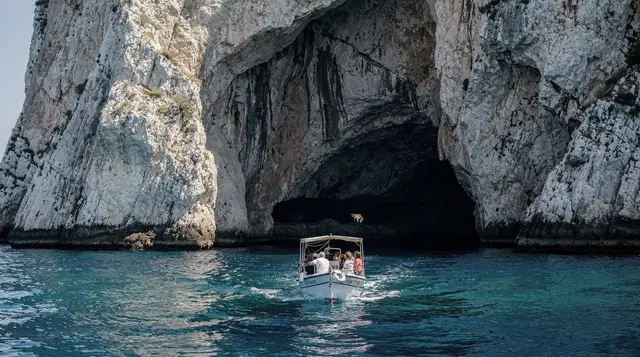
Renting a boat without a licence in Sardinia
Can I rent a boat in Sardinia without a boating licence?
Yes — Italian law allows anyone over 18 to drive a rental boat with an outboard engine up to roughly 40hp and no licence, provided the rental company gives a short safety briefing first. This covers most gommoni (rigid inflatables) used for coastal exploring, but not the larger cabin cruisers or anything over the power threshold.
Most visitors assume a boating licence is required to take the wheel in Sardinia, book a guided tour instead, and never realise self-drive was on the table. Italian maritime law actually allows anyone 18 or over to hire and pilot a small motorboat without a patente nautica (boating licence), as long as the outboard engine stays under the legal power threshold and the rental base runs a short briefing before handing over the keys. It’s the single best way to see a stretch of coast at your own pace, stop where you like, and skip the fixed itinerary of a group tour.
This guide covers the actual power and length limits, what a briefing involves, realistic prices for 2026, fuel costs, and the stretches of coast — mainly around Alghero and Arbatax — where licence-free rental works best. It also covers where it doesn’t: cabin cruisers, anything with more than one engine over the limit, and open-water crossings are outside what a no-licence rental legally covers.
| Who can rent | Anyone 18+, valid photo ID, no boating licence needed under the power limit |
| Power limit | Outboard engines up to around 40hp (roughly 30kW); higher power needs a licence |
| Typical boat | 5-6.5m rigid inflatable (gommone), 4-8 people |
| Cost | €150-350 for a half day, €250-550 for a full day, plus fuel |
| Deposit | €200-1,000 held on a card, refunded if the boat comes back undamaged |
| Best bases | Alghero, Arbatax, Cannigione, Santa Teresa Gallura, Villasimius |
The power limit that actually matters
The rule that governs no-licence rental is engine power, not boat size on its own. A rigid inflatable or small open motorboat with an outboard under roughly 40 horsepower can legally be driven by anyone over 18 without a patente nautica, provided the rental operator has confirmed the engine is within that limit and has briefed the renter on basic handling, navigation lights and the local no-wake zones. Above that power figure — which covers most larger cabin cruisers and twin-engine boats — Italian law requires a licence, and no reputable operator around Alghero or Arbatax will hand over the keys without checking for one.
In practice this means the boats on offer without a licence are gommoni in the 5 to 6.5m range, seating four to eight people, with a single outboard just under the threshold — plenty for exploring coves, not a boat built for open crossings to Corsica or the Bonifacio Strait. If you want something faster or bigger, the alternative is a skippered rental, where the boat and its power sit outside the no-licence bracket but someone else drives.
What the briefing actually covers
Every no-licence rental starts with an induction, usually 15 to 30 minutes, run by the base staff before you leave the marina. Expect a walk-through of the throttle and steering, how to read the depth and hazard markers along that stretch of coast, the VHF channel to hail if something goes wrong, and the no-wake and no-anchor zones specific to that bay — several coves inside Porto Conte Natural Park near Alghero restrict anchoring to protect the Posidonia seagrass beds. Some operators also do a short supervised lap outside the marina before letting you go solo. It is not a driving test in the way a car rental check is, but staff will refuse the boat to anyone who clearly can’t handle it, and they will hold the deposit against damage.
The self-drive inflatable boat rental from Alghero follows this exact format — briefing, fuel top-up, and a marked chart of where you can and can’t go inside the park. It’s the most straightforward starting point if this is your first time renting without a licence.
Realistic costs for 2026
Expect €150-250 for a half day (roughly four hours) on a 5-6m gommone, and €250-450 for a full day, before fuel. Fuel is rarely included — budget €30-60 for a half day of moderate cruising, more if you’re covering serious distance rather than pottering between coves. A refundable damage deposit of €200-1,000 is standard, held on a credit card and released within a few days of return assuming no scrapes on the hull or lost equipment. August pushes every one of these figures up 20-30%, and the best slots (morning departures, before the afternoon wind picks up) get booked out days ahead in peak season.
| Rental length | Boat type | Price range (excl. fuel) | Typical group size |
|---|---|---|---|
| Half day (4hrs) | 5-5.5m gommone | €150-250 | 2-5 people |
| Full day (8hrs) | 6-6.5m gommone | €250-450 | 4-8 people |
| Half day, larger inflatable | 6.5m+ gommone | €300-500 | 6-8 people |
Choosing the right boat for your group
Rental fleets in the no-licence bracket cluster around two sizes: a 5-5.5m gommone that comfortably seats two to five people with room for bags and a cool box, and a 6-6.5m version that stretches to six or eight. The bigger boat costs more per day but not proportionally more per person once you’re above four passengers, and it also handles a light chop more comfortably — worth factoring in in July and August, when afternoon wind is more common than the calm mornings the marketing photos show. Ask specifically about the boat’s beam (width), not just its length; a narrower 6m boat can feel less stable than a wider 5.5m one when several people move around at once, particularly when swimming off the back.
Bimini shade covers are standard on most rentals but not universal — worth confirming if you’re planning a full day out, since there’s little natural shade once you’re away from a cove’s cliffs. A few operators also offer a small step ladder or swim platform as standard, useful for getting back aboard after a swim stop without hauling yourself over the side, which matters more than it sounds after the third or fourth stop of the day.
A typical day self-driving a rental boat
Most renters follow a similar rhythm: collect the boat late morning after the briefing, motor gently out of the marina at the mandated no-wake speed, then open up once clear of moored boats and swimmers. From Alghero, a common route runs north-west toward Capo Caccia, stopping at two or three coves along the way for swimming, with lunch eaten on board or beached briefly at a quieter spot rather than at a restaurant. Fuel gauges on rental gommoni are usually simple and easy to misjudge — check the level at the midpoint of the day rather than waiting until it’s low, since running out of fuel a mile from the marina with no tow cover is a genuinely bad way to end an afternoon.
Return times are enforced more strictly than departure times; most bases charge a late fee by the half hour, and some hold part of the deposit if the boat comes back after dark without prior arrangement — night return isn’t covered by the basic briefing, since none of it addresses navigation lights or low-light hazard reading in any depth.
Safety equipment to check before you leave
Every legally rented no-licence boat should have, at minimum, a life jacket per passenger, a working VHF radio or the operator’s mobile contact number, a basic first aid kit, and a bailer or bilge pump. Ask to see all of this during the briefing rather than assuming it’s aboard — it’s a fair question, not an awkward one, and any operator worth renting from will happily show you. Check the fuel level yourself rather than taking the gauge reading on trust, and confirm what the plan is if the engine won’t restart mid-trip: most operators expect a phone call rather than an attempt to fix it yourself, and cell coverage is generally good along the Alghero and Arbatax coasts but patchy in some of the more sheltered coves beneath cliffs.
Where licence-free rental works best
Alghero’s coast is the standout base. The Porto Conte inlet is sheltered, which matters for first-time self-drivers, and it opens directly onto the limestone cliffs of Capo Caccia and a run of coves that are awkward to reach by road. The mini-yacht excursion from Alghero and the half-day options on a 15m sailing boat give a sense of the same stretch if you’d rather not drive yourself the first time out — see our Alghero and Capo Caccia boat trips guide for the full breakdown of that coastline.
On the east coast, Arbatax sits at the southern edge of the Gulf of Orosei, and self-drive rentals there reach quieter coves south of the main Cala Goloritzé and Cala Mariolu boat routes without needing a guide. It’s a more exposed stretch of water than Porto Conte, so check the wind forecast — a building maestrale can turn a calm morning into a rough afternoon by 2pm.
The aperitif boat tour around the Ogliastra islets from Arbatax is a guided alternative for the same coast if the forecast looks marginal for self-drive. Full detail on the wider Gulf of Orosei boat scene, including where the marine reserve rules apply, is in our Gulf of Orosei boat trips guide.
Around Cannigione and Santa Teresa Gallura in the north-east, no-licence rentals reach the edges of the La Maddalena archipelago’s more sheltered channels, though the core of the archipelago’s marine park has its own anchoring and speed restrictions worth reading before you go — see our La Maddalena archipelago boat tour guide.
What you can’t do without a licence
A no-licence rental is not a loophole for a full-day open-water crossing. Trips to Corsica, extended runs to the outer islands of the La Maddalena archipelago, or anything that takes you more than a mile or two from a sheltered coast fall outside what these boats and their engines are realistically built for, licence or not. Weather is the other hard limit: Sardinia’s coast has almost no natural harbours of refuge along long stretches, and a maestrale or mistral can build from a flat morning to a genuinely dangerous chop within a couple of hours, covered in our driving in Sardinia guide in the context of road planning but just as relevant to reading a marine forecast before setting out.
If open water or a faster boat is what you actually want, a skippered charter removes the power ceiling entirely — see our private versus group boat tours comparison for how a private skippered boat compares on price and flexibility to renting yourself.
Frequently asked questions about renting a boat without a licence
What’s the actual horsepower limit for a no-licence rental in Sardinia?
Roughly 40hp (about 30kW) on the outboard engine. Rental companies keep their no-licence fleet just under this figure; anything above it legally requires a patente nautica.
Do I need any boating experience at all?
No prior experience is required, but the base briefing is not optional — expect 15 to 30 minutes covering the controls, hazard markers and no-go zones for that specific stretch of water before you’re handed the keys.
Is fuel included in the rental price?
Almost never. Budget €30-60 for a half day and up to €80 for a full day of active use, paid either as a top-up on return or a fixed fuel allowance included in the quote — ask which when booking.
Can I take a rented boat to the La Maddalena archipelago without a licence?
Only the sheltered edges near bases like Cannigione or Palau — the open channels between the outer islands see stronger currents and wind than a no-licence rental is realistically built for. A guided boat is the safer way to see the full archipelago; see our La Maddalena archipelago boat tour guide.
What happens if the boat is damaged?
The deposit — typically €200-1,000 — covers minor damage, and the base will assess the hull and equipment on return. Serious damage or loss of the boat is charged beyond the deposit, so check whether the rental includes any insurance excess reduction before signing.
Is renting a boat cheaper than a guided tour?
For a group of four to six people splitting the cost, a half-day self-drive rental usually works out cheaper per person than an equivalent guided tour, though you lose the local knowledge of where to stop. Our private versus group boat tours guide breaks down the trade-off in more detail.
Which coast is easiest for a first-time self-drive rental?
Alghero, inside the sheltered Porto Conte inlet — calmer water, clearly marked hazards, and a short run out to genuinely dramatic scenery at Capo Caccia without needing to cross open water.
What safety equipment must be on board?
A life jacket per person, a working means of contacting the base (VHF or phone), a basic first aid kit, and a bailer or bilge pump are standard minimums. Ask to see all of it during the briefing before setting out.
Can I rent a boat without a licence outside the main summer season?
Yes, most operators run from April or May through October, though fewer boats are available and some smaller bases close entirely by late September. Shoulder-season rental has the advantage of quieter water and easier last-minute booking.
What happens if the weather turns while I’m out?
Return to the marina or the nearest sheltered cove immediately and radio or call the base — they can usually see conditions building on the same forecast you have access to and will often call renters in proactively if a squall is approaching.
Boat tours & cruises on GetYourGuide
Verified deep-linked GetYourGuide tours. Book through these links and we earn a small commission at no cost to you.
These are our own photographs of Sardinia, not the operator's pictures of this tour — open the tour page to see those.