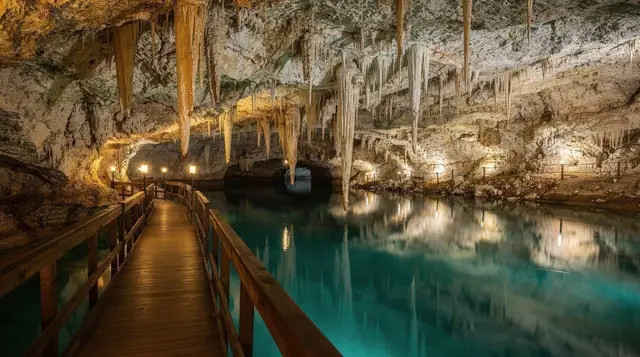
Ispinigoli cave near Dorgali and its 38-metre column
What makes Ispinigoli cave different from Sardinia's other show caves?
Ispinigoli is reached by road rather than boat, and its main feature is a single stalagmite column roughly 38 metres tall standing in an enormous vertical shaft — among the tallest of its kind in Europe. Excavations also found human remains linked to a theorised Punic-era ritual site, giving the cave an archaeological angle most Sardinian caves don't have.
Grotta di Ispinigoli, a few kilometres inland from Dorgali on the road toward Cala Gonone, is unlike most of Sardinia’s other well-known caves in one important way: you drive to it. There’s no boat crossing, no tide-dependent scheduling, just a car park, a short walk and a descent into a single enormous vertical shaft dominated by a stalagmite column that ranks among the tallest natural formations of its kind anywhere in Europe.
| Where | A few kilometres inland from Dorgali, on the road toward Cala Gonone |
| Access | By road — car park and a short walk to the cave entrance |
| Main feature | A single stalagmite column roughly 38 metres tall in a vertical shaft |
| Ticket | Around €10-12 adult, guided tour included |
| Time needed | About an hour for the guided walk |
The column and the shaft
The cave’s centrepiece is a vast, roughly circular shaft — deep enough and wide enough that early visitors compared it to a natural cathedral — with a single stalagmite column rising from the floor to somewhere near the ceiling, formed by mineral-rich water dripping from the same point for tens of thousands of years. At around 38 metres, it’s one of the tallest known stalagmite formations in Europe, and seeing it from the viewing platform, with daylight sometimes filtering down from an opening far above, is genuinely more dramatic than photographs suggest. The guided walk covers this main chamber along with several smaller connected galleries, at a measured pace that takes roughly an hour door to door.
The Punic sacrifice theory
Ispinigoli has an archaeological footnote most of Sardinia’s other caves don’t: excavations in the twentieth century uncovered human skeletal remains, mostly of infants and young people, in one of the cave’s chambers, leading some archaeologists to theorise a connection to Punic-era ritual practices recorded elsewhere in the ancient Mediterranean. The evidence is debated and the guided tour presents it as a theory rather than settled fact, but it adds a layer of genuine intrigue to what would otherwise be a purely geological stop — worth knowing before you go if you’d like to ask the guide about it directly, since English-language detail varies between guides and isn’t always volunteered unprompted.
How the column actually formed
The column’s formation followed the same basic process behind every stalagmite on earth, just sustained on an unusually large scale: mineral-rich water, seeping down through the limestone above and dripping from a single fixed point in the cave’s high ceiling, deposits a microscopic layer of calcite with every drop. Over tens of thousands of years, and helped by the shaft’s unusual height and consistent drip point, those layers built into the roughly 38-metre column visible today — thick enough at its base to look almost architectural, tapering toward the point where it nearly meets the ceiling far above.
Geologists studying the formation have used it, alongside similar giant columns elsewhere, to reconstruct historical climate patterns from the mineral banding, since growth rates vary with rainfall and temperature over geological time. Standing at the viewing platform, with the scale genuinely hard to judge without a fixed reference point nearby, is the moment most visitors describe as the highlight of the whole cave system.
Practical visitor information
The site typically opens with guided tours running at regular intervals through the day in the main season, with reduced frequency and shorter opening hours outside summer — worth confirming directly before a winter visit, since some show caves on the island close entirely for stretches of the low season.
A small ticket office and basic facilities sit at the entrance, though as with Ispinigoli’s rural setting generally, don’t expect a large visitor centre or extensive food options; most visitors eat either in Dorgali beforehand or continue to Cala Gonone afterwards. The guided tour language is typically Italian with English commentary included or available, though it’s worth asking at the ticket desk if a specific tour time guarantees an English-speaking guide during quieter shoulder-season periods when group sizes and staffing are smaller.
What else to do nearby
Ispinigoli sits close enough to several of the Supramonte’s other big draws that it rarely needs to be a dedicated half-day on its own. The Gorropu gorge, a short drive further inland, is the natural pairing for anyone with an interest in this limestone landscape, whether walked without gear or descended on rope as covered in the canyoning guide:
Gorropu canyon trek with off-road transfer and lunch from DorgaliDorgali’s winery scene, built on the region’s Cannonau vines, makes an easy afternoon pairing after a morning underground — several wineries run guided tastings a short drive from both Ispinigoli and the town itself:
Winery tour and tasting near Dorgali with a local guideFor a second cave on the same trip, Bue Marino near Cala Gonone is a genuinely different experience — reached by boat rather than road, and on a much larger scale — bookable as a boat-and-cave combination from the coast:
Boat trip to Bue Marino cave from Cala GononeInland toward Oliena, the Tiscali nuragic village hike combines a demanding walk with a genuinely unusual archaeological site — a Bronze Age settlement built inside a collapsed cave doline — for visitors who want to extend the cave-and-cavern theme into a hiking day:
Guided hike to the Tiscali nuragic village from OlienaIspinigoli in Sardinia’s wider show-cave story
Ispinigoli’s discovery and development as a tourist site followed a pattern common across Sardinia’s limestone regions — local knowledge of the cave’s existence long predating any formal exploration, followed by systematic mapping once speleology became an organised discipline on the island through the twentieth century, and finally the installation of lighting, walkways and a ticketed entrance once the site’s tourism potential was recognised.
What sets Ispinigoli apart from that broader story is how quickly the single column became the site’s entire identity — unlike Neptune’s Grotto or Bue Marino, which are known for a sequence of chambers and features across a longer walk, Ispinigoli is essentially a one-feature visit, and an unusually concentrated one at that. This isn’t a criticism so much as a reason to calibrate expectations: come specifically to see the column rather than expecting a sprawling underground network to explore.
Visiting with limited mobility or very young children
The path through Ispinigoli includes a meaningful number of steps and uneven natural rock surfaces without a step-free alternative route, which rules out wheelchair access entirely and makes the visit genuinely difficult for anyone with significant mobility limitations. For very young children, the main consideration is less the physical difficulty — most toddlers can manage the distance with some carrying — and more the guided pace and darker, echoing environment, which some very young visitors find unsettling rather than exciting.
Families with a mixed range of ages and abilities might find it easier to check with the ticket office about the quietest tour times, generally the first departure of the day, when a slower pace through the cave is more easily accommodated by guides than during a busy midday group.
How Ispinigoli fits a Dorgali or Cala Gonone stay
Visitors basing themselves in Dorgali or Cala Gonone for several days, which most people doing this stretch of the east coast do given the concentration of beaches, boat trips and caves within a short drive, will find Ispinigoli slots easily into a half-day alongside one other activity rather than needing its own dedicated day.
A common pattern is a morning at Ispinigoli followed by an afternoon at the beach or on one of the Gulf of Orosei boat trips, or the reverse — an early boat departure followed by Ispinigoli on the way back inland in the afternoon once the midday heat has passed its peak. Because the cave interior stays a constant, cool temperature regardless of the hour, there’s no strong reason to visit at any particular time of day beyond avoiding the busiest late-morning tour slots in August, when tour groups can back up at the entrance.
Getting there
Ispinigoli sits directly on the SP38 road between Dorgali and Cala Gonone, around a fifteen-minute drive from either, with parking at the site itself. There’s no public transport link direct to the cave, so a hire car is effectively required — see renting a car in Sardinia and driving in Sardinia if you haven’t arranged one yet. Day trips from Cala Gonone covers how to combine Ispinigoli with the coastal boat trips on the same short stay.
Ticket prices and family visits in 2026
Standard adult admission runs around €10-12, with a reduced rate typically €6-8 for children roughly aged 6-12 and free entry for younger children accompanied by an adult — exact age brackets are set locally and posted at the ticket office rather than published far in advance, so treat these as a planning guide rather than a guarantee. Family tickets covering two adults and up to two or three children sometimes offer a modest discount over buying individually, worth asking about at the counter rather than assuming it’s automatic.
Cash and card are both generally accepted, though carrying some cash is sensible given the rural setting and the real possibility of a card reader being temporarily out of action on a given day. There’s no meaningful cost difference between visiting in peak or shoulder season — pricing stays flat year-round — the only real seasonal variable is tour frequency, which thins outside summer as noted above. Combined tickets covering Ispinigoli alongside a second nearby attraction aren’t a fixed feature here, unlike some coastal caves that bundle with a boat trip, so budgeting separately for each stop on a Dorgali day is the safer assumption when planning.
Frequently asked questions about Ispinigoli cave
How tall is the famous column, exactly?
Roughly 38 metres, formed over an estimated tens of thousands of years by mineral-rich water dripping continuously from the same point in the cave’s high ceiling.
Do you need to book tickets in advance?
Advance booking generally isn’t necessary outside peak midsummer weekends; tickets are sold on-site and tours run on a fixed schedule throughout the day.
Is the cave suitable for people with mobility limitations?
The path includes steps and uneven surfaces without a wheelchair-accessible route; anyone with significant mobility limitations should contact the site directly before visiting.
Is the Punic sacrifice theory considered proven?
No — it remains a debated theory among archaeologists based on excavated remains, presented by guides as an interesting possibility rather than an established fact.
How does Ispinigoli compare to Bue Marino cave?
Ispinigoli is smaller in scope and reached by road, centred on a single dramatic formation; Bue Marino is reached by boat, covers a longer walkable gallery, and has a different, marine-linked history. Both are within easy reach of Dorgali and Cala Gonone, so visiting both on the same trip is realistic if caves interest you.
Can you combine Ispinigoli with the Gorropu gorge in one day?
Yes, comfortably — both sit within a short drive of each other and of Dorgali, and a morning cave visit followed by an afternoon Gorropu walk or guided trek is a common combination.
Is English commentary available on the guided tour?
Commentary is usually a mix of Italian and English, or English on request depending on the group and time of day; asking directly at the ticket desk about the next English-friendly tour is worth doing if language matters to your visit.
What should I wear inside the cave?
Comfortable closed shoes with grip, since the walkways can be damp and uneven in places, and a light layer for the noticeably cooler underground temperature compared to outside.
Does Ispinigoli have facilities like a café or shop?
Facilities are basic — a small ticket office and toilets — rather than a full visitor centre; plan to eat in Dorgali or Cala Gonone rather than expecting food options on site.
Is Ispinigoli worth visiting if I’ve already seen Neptune’s Grotto or Bue Marino?
Yes, if you’re specifically interested in cave formations — the scale of the single column is different enough from either boat-access cave to feel like a distinct experience rather than a repeat, and the visit is short enough that it doesn’t demand a full extra day to justify.
Can you photograph the column properly given the darkness?
Handheld cameras and phones generally cope well thanks to fixed lighting installed to illuminate the formation for exactly this purpose, though a steady hand or a camera with reasonable low-light performance produces noticeably better results than trying to capture the full 38-metre scale with a single wide shot on an older phone.
Is there anywhere to buy tickets online in advance?
Advance online booking isn’t standard for Ispinigoli specifically; tickets are bought on-site, which is workable outside the busiest weeks but worth building a small buffer into your schedule for during August when queues can form at peak tour times.
Cave & canyon tours on GetYourGuide
Verified deep-linked GetYourGuide tours. Book through these links and we earn a small commission at no cost to you.
These are our own photographs of Sardinia, not the operator's pictures of this tour — open the tour page to see those.