The Sinis peninsula sits on Sardinia’s west coast, a short drive from Oristano, and it packs an unusual amount into a small, flat area: a Phoenician-Roman city facing open sea, a 6th-century church older than most of Europe’s cathedrals, a lagoon thick with flamingos, and beaches made of quartz instead of sand. None of it requires a boat, a guide, or a hard hike — most of the peninsula is flat enough to cycle, which is exactly what a lot of visitors end up doing.
| Where | West coast, 15-20 minutes from Oristano by car |
| Cost | Tharros entry around €5-7; beaches free |
| Time needed | Half day for the highlights, a full day with beach time |
| Getting there | Car via the SP1 from Oristano; no useful bus-only route |
| Best time | Morning for Tharros before the heat; any time for the beaches, May-September for swimming |
Tharros: a Phoenician-Roman city with its columns still facing the sea
At the peninsula’s southern tip, Tharros was founded by Phoenician settlers in the 8th century BC, later expanded by Carthage and then Rome, and finally abandoned in the 11th century AD when its population relocated inland to what became Oristano — largely to escape Saracen raids along the exposed coast. What’s left is genuinely substantial for a site that doesn’t get anywhere near the crowds of Nora or Cagliari’s better-known ruins: a paved Roman road, the bases of Corinthian columns, a tophet (a Phoenician sacred precinct), thermal baths, and a defensive tower with the sea on three sides.
Entry runs around €5-7 depending on the season and whether a combined ticket with the nearby antiquarium is offered. The site is exposed with almost no shade, so a morning visit — ideally before 10am in summer — is a real practical recommendation, not just a nicety. For deeper background on the ruins themselves and how they compare to Sardinia’s other archaeological sites, see the Tharros archaeological site guide and the broader nuraghi and ancient Sardinia guide.
San Giovanni di Sinis: one of the oldest churches in Sardinia
Right at the entrance to Tharros sits San Giovanni di Sinis, a small, austere Byzantine church dating to the 6th century, making it one of the oldest surviving churches on the island. It’s free to look at from outside and often open for a quick visit; there’s no ticket booth and no queue, which makes it an easy add-on rather than a separate stop. The building’s plain stone exterior and cross-shaped floor plan are worth a few minutes even for visitors who aren’t especially drawn to church architecture, mostly for the sheer age of the thing standing essentially alone on an open, windswept headland.
The quartz beaches: Is Arutas, Mari Ermi and Maimoni
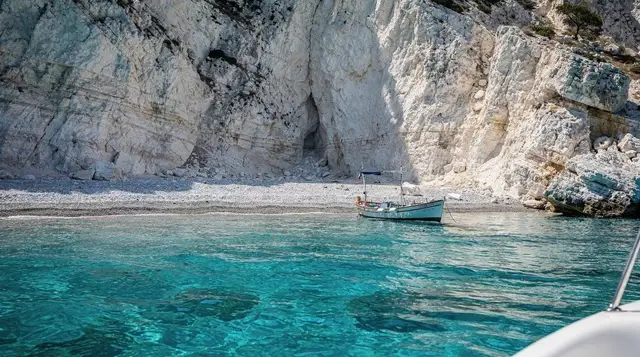
The peninsula’s most photographed feature isn’t archaeological — it’s geological. Is Arutas,** Mari Ermi** and** Maimoni** are beaches made almost entirely of small, rounded quartz grains rather than sand, ranging from rice-grain size at Is Arutas to pea-sized pebbles at some stretches of Mari Ermi. The quartz catches light in a way ordinary sand doesn’t, and in clear water the effect is genuinely striking rather than just a marketing line.
For the fuller context on why these beaches look the way they do and how they compare to the rest of the island’s coastline, see the quartz beach guide to Is Arutas and the guide to Sardinia’s beach access quotas — the Sinis beaches don’t currently require booking, unlike Stintino’s La Pelosa or Cala Goloritzé further east, but the sand-removal ban applies everywhere.
Stagno di Cabras: flamingos and a working lagoon
The peninsula’s inland edge is bordered by the Stagno di Cabras, Sardinia’s largest lagoon, which supports a genuine fishing economy alongside its wildlife. Pink flamingos are a near-constant presence, particularly in the shallower margins, and the lagoon is the source of** bottarga di Cabras** — pressed, dried mullet roe considered one of the best in Sardinia and sold directly by the fishing cooperatives in Cabras itself.
Local fishermen still use fassonis, small boats woven from lagoon reeds, a construction technique with almost no equivalent left in Europe outside a handful of preserved examples. For more on the food itself, see the bottarga of Cabras guide; for the wider birdlife picture, Sardinia’s wildlife guide covers where else flamingos and other lagoon species turn up around the island.
Flat, windy, and built for cycling
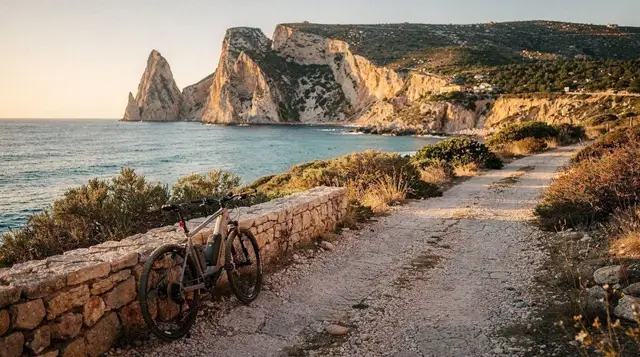
Unlike most of Sardinia’s coastline, the Sinis peninsula is almost entirely flat, which makes it one of the easier places on the island to explore by bike or e-scooter rather than by car for short hops between sites. The wind that makes the beaches occasionally uncomfortable is the same wind that makes Putzu Idu, just north of the peninsula proper, one of Sardinia’s better kitesurfing spots, alongside the more open water around** Mal di Ventre** island offshore. A guided mountain bike route through the peninsula is one of the more efficient ways to link Tharros, the quartz beaches and the lagoon views without doubling back by car:
Sinis peninsula mountain bike tourFor a lower-effort option that still covers the archaeology, an e-scooter route out of nearby Cabras reaches some of the same ground:
Tour of the Giants by e-scooter from CabrasSee the kitesurfing in Sardinia guide and cycling in Sardinia for gear rental and conditions specific to this stretch of coast.
San Salvatore: an accidental spaghetti western set
A few minutes north of Tharros, the tiny village of San Salvatore is built around a paleo-Christian hypogeum church sunk partly underground — but it’s better known locally for a stranger reason: its bare, dusty streets were used as a ready-made set for a string of low-budget Italian and Spanish westerns in the 1960s and 70s, when the genre was booming and Sardinia was cheaper to film in than the American Southwest. A handful of the false-fronted buildings from that era are still standing. It’s a curiosity rather than a must-see, best combined with a stop in Cabras rather than visited on its own.
Getting there and around
A car is the only realistic way to see the peninsula properly; the SP1 from Oristano reaches Cabras and the Sinis turnoffs in about 15-20 minutes, and internal roads between Tharros, the quartz beaches and San Salvatore are narrow but well-signed. There’s no useful public bus network covering the beaches directly. See renting a car in Sardinia and driving in Sardinia for the practicalities — and note that average driving speeds across the island run closer to 60km/h than what a map’s distance might suggest, even on a peninsula this flat.
For a single guided day that strings the highlights together without self-driving between them:
Oristano and Sinis peninsula day tripA realistic day plan
Morning: Tharros and San Giovanni di Sinis before the heat builds, roughly 1.5-2 hours including the walk around the ruins. Midday: a swim and a few hours at Is Arutas or Mari Ermi, packing your own shade and water since services on the beaches themselves are minimal. Late afternoon: Cabras for bottarga tasting and a look at the Giants of Mont’e Prama in the town’s museum, covered in more depth in the Giants of Mont’e Prama guide. This whole loop fits inside a single day trip from Oristano and doesn’t require an overnight stay, though where to stay in Sardinia has options if you’d rather base yourself locally for a couple of nights.
What isn’t worth the detour
Not every quartz beach on the peninsula is worth chasing down individually — several smaller, unnamed coves between Is Arutas and Mari Ermi have the same quartz composition without any particular advantage over the two named beaches, and driving further to find a marginally quieter unnamed stretch usually costs more time than it saves. Similarly, San Salvatore’s western-film history is a five-minute curiosity, not a destination in its own right; visitors expecting a preserved film set are usually mildly disappointed by how little remains.
Frequently asked questions about the Sinis peninsula
Is Tharros worth visiting if I’ve already seen Nora?
Yes, and for a different reason — Tharros has a more dramatic coastal setting with columns and ruins directly facing open water on a narrow headland, while Nora sits in a more sheltered bay near Pula. The two sites complement rather than duplicate each other, and Tharros is considerably less crowded.
Do I need to book Is Arutas or the other quartz beaches in advance?
No. Unlike La Pelosa near Stintino or Cala Goloritzé in the east, the Sinis quartz beaches currently have no reservation system or entry quota. Parking can still fill up in August, so arriving before mid-morning is the practical workaround.
Can I combine the Sinis peninsula with a trip to Bosa or Alghero?
It’s possible but tight as a single day — the drive north to Bosa is roughly 1.5-2 hours on non-motorway roads. Most visitors treat the Sinis peninsula as a standalone day from Oristano rather than folding it into a northwest coastal itinerary.
Is the Cabras lagoon safe to swim in?
The lagoon itself isn’t set up for swimming — it’s shallow, muddy in places and used for fishing rather than recreation. The actual swimming beaches (Is Arutas, Mari Ermi, Maimoni) are on the open sea side of the peninsula, a short drive from the lagoon.
What should I eat while I’m here?
Bottarga di Cabras is the obvious choice, either as a tasting at a fishery shop in Cabras or shaved over pasta at a local restaurant. Fregola with clams and mullet-based dishes also show up regularly on menus in Oristano and Cabras, reflecting the lagoon’s role in the local diet.
Is a full day enough, or should I stay overnight?
A full day covers the highlights comfortably if you start early. An overnight stay in Oristano or Cabras makes sense mainly if you want unhurried time at more than one quartz beach or plan to combine the peninsula with day trips from Oristano further afield, such as Barumini’s nuraghe.