Tharros, the Phoenician-Roman city on the Sinis peninsula
What's left to see at Tharros, and how long does it take?
Tharros has standing Roman columns, a tophet sanctuary, bath complexes, a paved decumanus street with visible drainage, and the 16th-century Torre di San Giovanni above it. Budget 90 minutes to two hours for the site, longer if you combine it with the nearby San Giovanni di Sinis church or the quartz beaches a few minutes further along the peninsula.
Tharros sits on a narrow spit of land at the southern tip of the Sinis peninsula, with the open sea on one side and the calm Gulf of Oristano on the other — a strategic choice the city’s Phoenician founders clearly understood, since it gave them shelter for boats whichever way the wind was blowing.
Unlike the nuragic towers covered in our guide to Sardinia’s nuraghi, Tharros belongs to a later and very different period: it’s a Phoenician trading post that grew into a substantial Punic and then Roman city, and what’s left standing today — columns, a paved street, bath complexes, and a 16th-century Spanish watchtower looking out over it all — spans well over a thousand years of continuous use before the city was finally abandoned.
It’s the closest major archaeological site to Cabras and Oristano, and one of the more atmospheric ruins in Sardinia precisely because of where it sits: walk to the end of the excavated area and you’re standing on a headland with a beach on either side, ruins underfoot and, on a clear day, the outline of the Sinis coastline curving away to the north.
| Where | Southern tip of the Sinis peninsula, 20 minutes from Cabras and Oristano |
| Founded | c. 8th century BC, Phoenician trading post |
| Peak period | Punic city (6th–3rd century BC), then Roman colonia |
| Abandoned | Gradually through the early Middle Ages, likely Saracen raids and malaria |
| Entry cost | Around €8–12, self-arranged |
| Best time | Morning, April–June or September–October |
From Phoenician trading post to Roman city
Tharros was founded, most likely in the 8th century BC, by Phoenician traders looking for a sheltered stopping point along the sea route between the eastern Mediterranean and the Iberian peninsula — the same pattern of coastal outposts that produced Nora further south. It grew quickly into a genuine city under Punic (Carthaginian) control from around the 6th century BC, with a tophet — a sanctuary associated with infant burial urns, a controversial and still-debated feature of Punic religious practice found at several Phoenician-founded sites around the western Mediterranean — established on the hill above the settlement.
Rome absorbed Tharros along with the rest of Sardinia after the First Punic War in the 3rd century BC, and the city continued as a working Roman colonia for centuries afterward, acquiring the baths, paved streets and civic infrastructure that make up most of what’s visible on site today.
Its slow decline came later still, through the early Middle Ages, as Saracen raids made the exposed, undefended coastline increasingly dangerous to inhabit and malaria from the surrounding wetlands took its toll — much the same combination of pressures that eventually emptied Nora further down the coast. By around the 11th century, the population had largely relocated inland to what’s now Oristano, and Tharros was left to the elements, which — as at so many abandoned Mediterranean sites — is precisely why so much of it survived to be excavated centuries later.
What’s actually standing on site today
The most photographed feature is a row of Corinthian columns, re-erected from fallen fragments during 20th-century restoration work, marking the site of what’s thought to have been a Roman temple or civic building near the main street. The decumanus, Tharros’s principal paved street, runs through the site with its original drainage channels still visible cut into the stone — a rare chance to see genuine Roman civil engineering rather than just building foundations. Two** bath complexes** — one Punic in origin, later rebuilt by Roman engineers, and a larger Roman-era set of baths closer to the sea — retain enough of their hypocaust heating systems and basin walls to make sense of how they worked.
Above the residential and civic quarter, on the hill overlooking the site, the tophet sanctuary marks one of the more significant and debated religious features of the Punic period — the interpretation of infant urn burials found at tophet sites remains a live academic argument, and the site’s information panels present the evidence rather than a settled conclusion.
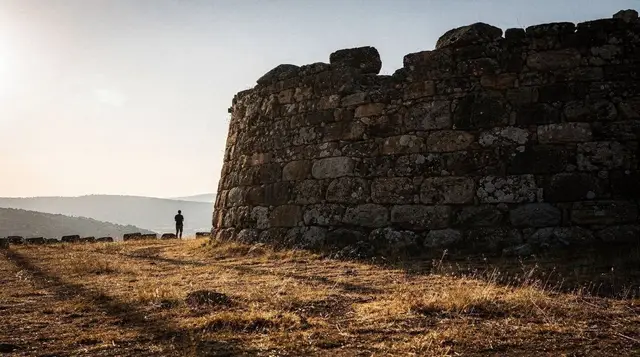
At the tip of the headland, a squat 16th-century watchtower, the Torre di San Giovanni, was built by the Spanish crown to watch for Barbary corsair raids — a reminder that this coastline stayed dangerous for the better part of a millennium after the Roman city itself had emptied out, and it’s worth climbing the base of the tower for the best overview of the whole excavated area.
| Feature | Period | What to look for |
|---|---|---|
| Corinthian columns | Roman | Re-erected fragments marking a civic building |
| Decumanus street | Roman | Paved surface with visible drainage channels |
| Punic and Roman baths | Punic origin, Roman rebuild | Hypocaust heating, basin walls |
| Tophet sanctuary | Punic | Hilltop sanctuary, debated infant-urn burials |
| Torre di San Giovanni | 16th century Spanish | Watchtower with the best overview of the site |
San Giovanni di Sinis: the paleo-Christian church next door
A short walk or drive from the ticket office, the tiny village of San Giovanni di Sinis holds one of the oldest churches in Sardinia — a squat, cross-shaped paleo-Christian building dating in its earliest form to around the 5th or 6th century AD, with later Byzantine and Romanesque additions. It’s a functioning parish church rather than a museum piece, generally open for a quick look, and worth the five-minute detour before or after Tharros itself: it’s a physical link between the Roman city’s final centuries and the fishing village that eventually replaced it on the same stretch of coast.
The museum finds: where the movable artefacts went
Excavations at Tharros over more than a century have produced a substantial haul of pottery, jewellery, coins and votive objects spanning the site’s Phoenician, Punic and Roman phases, most of which is now held in Sardinia’s regional archaeological museums rather than displayed on site — the same pattern seen at Nora, where movable finds sit in Pula’s Museo Patroni rather than among the ruins themselves.
Tharros’s own finds are split between collections in Oristano and Cagliari’s Museo Archeologico Nazionale, which also holds the nuragic bronzetti figurines covered in our nuraghi of Sardinia guide. Visiting one of these museums before or after the ruins fills in detail — jewellery styles, trade-good origins, coin mints — that the site’s own information panels only briefly touch on, and it’s worth building into an Oristano-based day if artefacts interest you as much as architecture.
Getting to Tharros and touring the Sinis peninsula
From Cabras, Tharros is about a fifteen-minute drive along the peninsula road, and from Oristano closer to 30 minutes; there’s no useful public bus service covering the route directly, so a hire car or an organised tour is the practical way to get there. See our renting a car in Sardinia guide if you haven’t arranged one yet, and note that Sardinia’s real average driving speed away from the SS131 dual carriageway is closer to 60km/h than a map distance suggests.
For a lower-effort way to cover Tharros alongside the rest of the Sinis peninsula’s ruins and beaches, the Sinis peninsula mountain bike tour from Oristano loops through Tharros, the lagoon views near Cabras and the quartz beach at Is Arutas in a single guided outing, which avoids the hassle of parking and driving between every stop yourself.
An e-scooter option based in Cabras itself, the Tour of the Giants by e-scooter, focuses more on the town and the Museo Civico’s Mont’e Prama statues but can be combined with a separate Tharros visit on the same day. For visitors staying further away and treating this as a single day out from a wider base, the Oristano and Sinis peninsula day trip covers Tharros as part of a fuller loop of the area.
Parking at the Tharros site itself is straightforward outside peak August weeks, with a car park a short walk from the ticket office; it does fill by mid-morning in July and August, so an early arrival — before 10am — avoids both the parking squeeze and the worst of the exposed midday heat, since there’s minimal shade anywhere on site.
The beaches either side of the ruins
Two beaches flank the Tharros headland: San Giovanni di Sinis to the north, a long stretch of pale sand backed by the village and its church, and a smaller, rockier cove closer to the ruins themselves on the southern side. Neither carries a booking quota the way La Pelosa does further north, so you can visit and swim without advance planning, though the same island-wide rule against removing sand applies here as everywhere else — fines run from €500 to €3,000, and it’s genuinely enforced in high season.
See our guide to Sardinia’s beach access quotas for which beaches do require booking; Tharros’s own beaches aren’t among them. For the peninsula’s more distinctive quartz sand a short drive further north, see our Is Arutas quartz beach guide.
What to pack for a Tharros visit
Beyond the sun protection already mentioned, closed shoes are worth having even though the paths are generally more even than at nuragic sites like Su Nuraxi — some of the paved Roman street sections have uneven, worn stone that catches sandals more than trainers. If you’re planning to swim at either beach afterward, pack accordingly, since there are no changing facilities directly at the archaeological site itself, only at the beaches nearby. A printed map or downloaded offline guide is useful too, since mobile signal on the exposed headland can be patchy at times, even though it’s only a short drive from a well-connected town.
Where Tharros fits on a wider trip
Tharros pairs naturally with a day covering Cabras’s bottarga shops and the Mont’e Prama giants in the town’s Museo Civico — see our Giants of Mont’e Prama guide for that connection — and with a wider loop of Oristano itself.
For a longer archaeology-focused trip that also takes in Barumini’s Su Nuraxi and Nora, see our nuragic route across Sardinia or the dedicated seven-day archaeology itinerary. Anyone building a broader west-coast trip from scratch can use our seven-day west coast Sardinia itinerary as a template, with Tharros as a natural half-day stop early in the route.
Frequently asked questions about visiting Tharros
How long do you need at Tharros?
Most visitors need 90 minutes to two hours to see the site properly, including the climb up to the Torre di San Giovanni for the overview. Add 15 to 20 minutes if you’re also stopping at the San Giovanni di Sinis church next door.
Is Tharros better than Nora or Barumini?
They’re different periods and settings rather than directly comparable — Tharros is Phoenician-Punic-Roman on an exposed peninsula, Nora is Punic-Roman on the south coast with a more complete Roman theatre, and Barumini’s Su Nuraxi is Bronze Age nuragic and inland. A serious history trip through Sardinia takes in all three rather than choosing just one; see our island-wide nuraghi guide for how nuragic sites differ from these later Phoenician and Roman ones.
Can you swim at Tharros?
Yes — two beaches flank the ruins, San Giovanni di Sinis to the north and a smaller cove closer to the site itself, both open to swim without any advance booking or quota.
Is Tharros suitable for children?
Reasonably, though there’s little shade and the ground is uneven in places; the beaches on either side make a good reward for getting through the ruins first, similar to the pairing at Nora.
What’s the tophet, and why is it controversial?
The tophet is a hilltop sanctuary associated with urns believed by many archaeologists to hold infant remains, a practice found at several Phoenician-founded Mediterranean sites. Its exact interpretation — ritual sacrifice, high infant mortality burial, or something else — remains genuinely debated among specialists rather than settled fact.
Does Tharros get busy in summer?
Yes, particularly late morning in July and August, when day-trippers from Oristano and the Sinis beaches overlap with the archaeology crowd. An early visit before 10am avoids most of both the heat and the car park queue.
Where are the artefacts found at Tharros displayed?
Most movable finds — pottery, jewellery, coins, votive objects — are held in regional collections in Oristano and in the Museo Archeologico Nazionale in Cagliari rather than on site at Tharros itself, similar to how Nora’s finds are kept in Pula’s museum rather than among the ruins.
How does Tharros compare to Nora in terms of what survives?
Nora generally has more complete standing structures, including an intact Roman theatre, while Tharros’s strength is its setting and the combination of visible Phoenician, Punic and Roman layers on one exposed headland. See our Nora archaeological site guide for the direct comparison.
Nuraghi & archaeology tours on GetYourGuide
Verified deep-linked GetYourGuide tours. Book through these links and we earn a small commission at no cost to you.
These are our own photographs of Sardinia, not the operator's pictures of this tour — open the tour page to see those.