A nuragic route across Sardinia
What is the best nuragic route to follow in Sardinia?
A loop from Alghero (Nuraghe Palmavera) south through Torralba (Santu Antine) to Barumini (Su Nuraxi, the island's only UNESCO nuraghe) covers the three most complete sites in one drive of roughly 3-4 hours of pure driving time, spread across 2-3 days with the Giara plateau, Cabras and Nora added on.
Sardinia has around 7,000 nuraghi — the Bronze Age stone towers that give the island its most distinctive monuments — plus a layer of older rock-cut tombs and a later one of Phoenician, Punic and Roman ruins built on top of and alongside them. Most visitors see one site and call it done. This route links the handful that are genuinely worth the drive, in an order that keeps the driving sensible rather than criss-crossing the island. It works as a dedicated 2-3 day archaeology trip or as a series of day trips slotted into a longer stay, see nuraghi of Sardinia for the wider background on what a nuraghe actually is before setting off.
| Where | North-west to south, via the interior: Alghero, Torralba, Barumini, Cabras, Cagliari area |
| Cost | €5-15pp per site; several require a guided tour included in the ticket |
| Time needed | 2-3 days as a dedicated route; individual stops work as day trips too |
| Getting there | A hire car is essential — none of these sites are realistically linked by bus |
| Best time | Year-round; spring and autumn avoid both the heat and the coach-tour crowds |
What a nuraghe actually is, before setting off
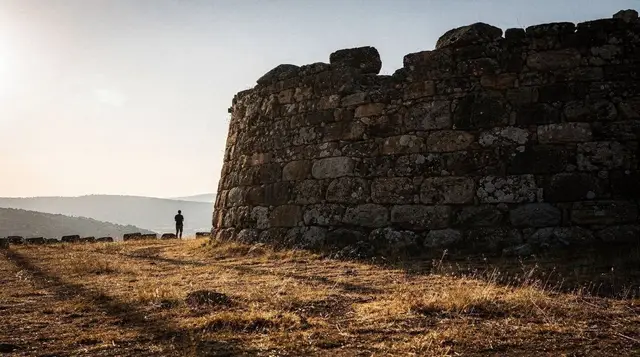
A nuraghe is a conical tower built from massive, unmortared stone blocks, dating from the Sardinian Bronze Age, roughly 1900 to 730 BC. Nobody has settled definitively on what they were originally for — theories range from defensive strongholds to grain stores to territorial markers, and it’s entirely possible different nuraghi served different purposes depending on when and where they were built.
What’s clear from the archaeology is that they were a huge undertaking: Su Nuraxi’s central tower alone required moving and stacking thousands of basalt blocks without mortar, using nothing but timber levers and ramps, by a society that left no written records to explain how. The word “nuraghe” itself has no confirmed Latin or Italian root, which is one small piece of evidence for how old and distinct the culture that built them really was. Nuraghi of Sardinia covers the full typology, from simple single-tower structures to the complex, multi-tower fortresses like Su Nuraxi that this route focuses on.
Nuraghe Palmavera, the north-west’s easiest stop
Just outside Alghero on the road toward Porto Conte, Nuraghe Palmavera is the second-largest nuragic complex on the island after Barumini — a main tower plus a second, unusually large circular hut and the remains of around 50 smaller dwellings spread across the site. It’s flat, well signposted and close enough to Alghero’s old town that it slots easily into a half-day alongside the coast, covered in full in Alghero old town guide.
Visit to Nuraghe Palmavera and Porto Conte park from AlgheroEntry alone runs around €5-7; guided visits that bundle in Porto Conte park cost more but add context that the site’s sparse signage doesn’t provide on its own. Give it 45-60 minutes.
Santu Antine, the tallest surviving tower
An hour or so inland from Alghero, near Torralba, Nuraghe Santu Antine is nicknamed “sa domo de su re” — the king’s house — for the scale of its central tower, one of the tallest nuragic structures still standing at close to its original height. The drive there runs through the Valle dei Nuraghi, a stretch of the SS131 where you can spot half a dozen more nuraghi from the road without stopping, a good sense of just how dense this landscape once was with them.
Bosa and Santu Antine private experience from CagliariIf driving the route independently rather than booking a tour, Santu Antine is easily combined with a stop in Bosa on the coast, covered in Bosa town guide — the two sit roughly 40 minutes apart on minor roads through the Temo valley.
Su Nuraxi di Barumini, the only UNESCO nuraghe
Barumini is the centrepiece of any nuragic route and, for most visitors, the one site on this list that genuinely can’t be skipped. Su Nuraxi is Sardinia’s only UNESCO World Heritage nuraghe — a central tower over 3,500 years old surrounded by four corner towers and a village of stone huts that was still inhabited into the 3rd century BC. Entry is only possible with a guided tour, included in the ticket price, and departures run roughly every 30-40 minutes through the day rather than on a fixed schedule.
Su Nuraxi di Barumini UNESCO site guided tourFull details of visiting hours, ticket prices and what the guided tour actually covers are in Su Nuraxi Barumini guide. Budget 60-90 minutes on site, more if combining with the Casa Zapata museum in the village itself, which displays finds from the excavation over the top of its own smaller nuraghe remains found beneath the building.
How the three main sites compare
Palmavera, Santu Antine and Su Nuraxi each show a different side of nuragic building, and it’s worth knowing what sets them apart before deciding how many to fit in.
| Nuraghe Palmavera | Santu Antine | Su Nuraxi di Barumini | |
|---|---|---|---|
| Standout feature | Large second hut alongside the tower, plus 50 smaller dwellings | Height of the central tower, near its original scale | Only UNESCO-listed nuraghe; four corner towers plus village |
| Entry | Self-paced or guided | Self-paced or guided | Guided tour only, included in ticket |
| Time needed | 45-60 minutes | 45-60 minutes | 60-90 minutes |
| Crowds | Moderate, less than Su Nuraxi | Low, off the main tourist circuit | High in July and August |
| Nearest base | Alghero, 15 minutes | Torralba/Sassari area, 45 minutes from Alghero | Barumini, 50 minutes from Cagliari |
Santu Antine is the quietest of the three by a clear margin, largely because it sits away from both main coastal bases — worth prioritising for anyone who wants a nuragic site without the coach-tour atmosphere that Su Nuraxi picks up at peak season.
The Giara di Gesturi, wild horses on the same afternoon
A 15-minute drive from Barumini, the Giara di Gesturi is a basalt plateau best known for its wild horses, the cavallini della Giara — a small, distinct breed found nowhere else. It isn’t a nuragic site itself, but combining it with Su Nuraxi makes practical sense given the short distance, and several tours package the two together with a stop for wine tasting on the way back down.
Barumini nuraghe and Giara park tour with wine tastingMont’e Prama and the giants of Cabras
West toward the coast, Cabras is home to the Giants of Mont’e Prama — a set of monumental stone statues, some close to 2 metres tall, discovered in a farmer’s field in 1974 and now recognised as one of the most significant nuragic-era finds on the island. The originals are split between the museum in Cabras and the archaeological museum in Cagliari; the Cabras museum is the smaller, more focused of the two and worth the detour on its own, detailed further in the giants of Mont’e Prama.
Tour of the giants of Mont’e Prama by e-scooterCabras also sits at the gateway to the Sinis peninsula, where the Phoenician-Punic-Roman ruins of Tharros add the layer of history that sits on top of the nuragic one — worth an extra hour if the route allows it, and a natural stop before heading toward Oristano for the night.
Nora, where the layers stack up on the coast
The route’s southern anchor is Nora, near Pula on the coast south-west of Cagliari — a Phoenician foundation later built over by Carthage and then Rome, with a section of the ancient city now partly submerged just offshore. It isn’t a nuragic site, but it closes the loop on how the island’s ancient layers sit on top of one another, and it’s an easy add-on to a day that starts in Cagliari.
Nora archaeological site private day tour from CagliariFull practical detail on visiting hours, the theatre and the mosaics still visible on site is in Nora archaeological site.
Two more stops if time allows
Two sites don’t sit neatly on the west-to-south line above but are worth building in if the itinerary has room. Arzachena archaeological park, in the north-east near Arzachena, groups a tomb of the giants, a nuraghe and a stone circle within a short walk of each other — useful if the trip also covers the Costa Smeralda. And Tiscali, a nuragic village built inside a collapsed doline in the Supramonte massif, is the one entry on this list that isn’t reachable by car at all — it’s a two-hour hike each way, but the setting, a village hidden inside a mountain, is unlike anything else on the island.
The older layer: domus de janas and tombs of the giants
Nuraghi aren’t the oldest structures on this route. Domus de janas — literally “fairy houses” — are rock-cut tombs carved directly into hillsides across the island, predating the nuragic civilisation by well over a thousand years in some cases, with necropolises scattered from the Sinis peninsula to the Sulcis-Iglesiente in the south-west.
Tombs of the giants, by contrast, are nuragic-era collective burial monuments, long stone corridors fronted by a distinctive curved stone facade, and the best-preserved examples sit in the Arzachena archaeological park in the north-east. Neither fits neatly into the west-to-south driving line this route follows, but both are worth building into a longer stay — see domus de janas of Sardinia and tombs of the giants Sardinia for where to find the best examples of each.
What this route costs, roughly
Budgeting for the full route is straightforward since most sites charge similar entry fees. Expect €5-7 for Palmavera, €5-8 for Santu Antine, and €13-15 for Su Nuraxi’s mandatory guided tour, with the Casa Zapata museum in Barumini village adding a few euros more if visited separately. Cabras’ Mont’e Prama museum runs around €5-9 depending on whether it’s combined with the Cagliari collection, and Nora’s entry sits around €10-12.
All told, a solo traveller doing every stop on this page spends somewhere between €45 and €65 on entry fees alone across the full route, before fuel, food or accommodation — modest against the density of what’s covered, but worth planning for if the trip includes several other paid attractions elsewhere on the island.
Suggested order over 2-3 days
Day one: Alghero base, Nuraghe Palmavera in the morning, Santu Antine after lunch on the way inland. Day two: Barumini and the Giara in the morning, Cabras and Tharros in the afternoon, overnight around Oristano or push on toward Cagliari. Day three: Nora as a half-day from Cagliari before flying out of Cagliari-Elmas airport. The full archaeology-focused version of this route, built out day by day with driving times, is in Sardinia archaeology 7 days.
Frequently asked questions about a nuragic road trip in Sardinia
How many nuraghi are actually open to visitors?
Only a small fraction of the roughly 7,000 nuraghi across the island are excavated and open, with Su Nuraxi di Barumini, Palmavera and Santu Antine the three most visited and best equipped for tourists.
Is Su Nuraxi di Barumini worth the entry price?
Yes — it’s the only UNESCO-listed nuraghe on the island, the guided tour is included in the ticket, and the site’s condition and scale are noticeably better preserved than most alternatives.
Can this route be done without a car?
Not realistically. None of these sites have reliable bus connections between them, and the whole point of the route is stringing several together in a day, which a hire car makes possible and public transport doesn’t.
How long does it take to see Su Nuraxi?
The guided tour itself runs 45-60 minutes; add extra time for the on-site museum and, if visiting, the Casa Zapata museum in the village.
Are the sites suitable for children?
Palmavera and Su Nuraxi are both manageable with children old enough to walk on uneven stone terrain; Tiscali’s two-hour hike each way is not suitable for young children.
What should I combine Barumini with on the same day?
The Giara di Gesturi plateau, a 15-minute drive away, is the natural pairing — its wild horses give the day a change of pace after two nuragic sites.
Is there shade at these sites?
Very little. Palmavera and Su Nuraxi are both largely exposed; a hat and water matter more here than at most Sardinian attractions, especially in July and August.
What’s the difference between a nuraghe and a domus de janas?
A nuraghe is a Bronze Age stone tower, built up above ground; a domus de janas is a much older rock-cut tomb, carved down into a hillside — the two belong to different periods of Sardinian prehistory rather than being variations on the same structure.
Do I need to book tickets in advance?
For Su Nuraxi in July and August, booking a day or two ahead is sensible given how popular the guided tours are; outside peak season, and at Palmavera and Santu Antine year-round, turning up without a booking is usually fine.
Nuraghi & archaeology tours on GetYourGuide
Verified deep-linked GetYourGuide tours. Book through these links and we earn a small commission at no cost to you.
These are our own photographs of Sardinia, not the operator's pictures of this tour — open the tour page to see those.