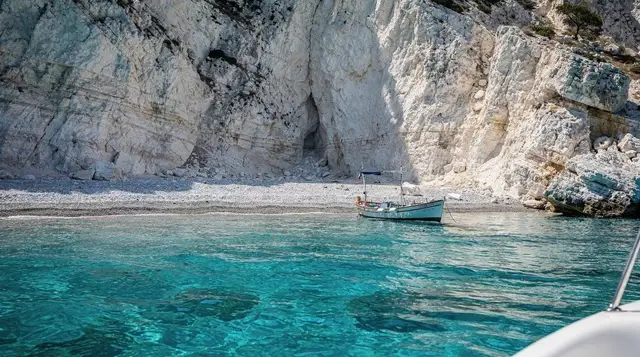
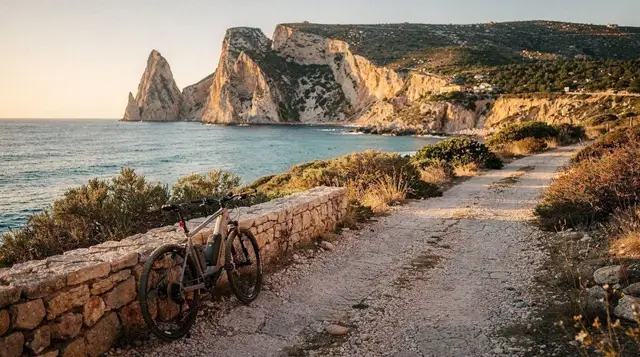
Santa Teresa Gallura sits at the very top of Sardinia, close enough to Corsica that on a clear day the French island’s cliffs are visible across the Strait of Bonifacio without binoculars. That geography defines the town: it’s the departure point for the year-round car ferry to Bonifacio, a genuinely good base for exploring both the eastern edge of the La Maddalena archipelago and Corsica itself, and home to Capo Testa, a headland of wind-sculpted granite boulders and turquoise coves that rivals anything on the Costa Smeralda without the prices.
The town centre is small and pleasant — a central piazza, a scattering of restaurants serving Corsican-influenced seafood, and a clifftop promenade above Rena Bianca, the main town beach, which is genuinely one of the best in-town beaches in Gallura: fine white sand, shallow turquoise water, and a five-minute walk from any hotel in the centre.
That combination of a real town centre, a genuinely good beach on the doorstep, and an international ferry route sets Santa Teresa Gallura apart from most of the rest of Gallura’s coast, where the choice is usually between a purpose-built resort town or an isolated beach with nothing else nearby. It’s also noticeably less manicured than Porto Cervo or Porto Rotondo — expect a working fishing harbour alongside the tourist boats, and prices that, while not cheap, sit well below the Costa Smeralda’s more exclusive addresses.
Capo Testa and Valle della Luna
Capo Testa, 4km west of town, is the reason many people put Santa Teresa Gallura on their itinerary at all. The headland is a maze of granite boulders shaped by wind into rounded, almost sculptural forms, with narrow paths threading between them to a series of small coves — Cala Grande, Cala Spinosa, Cala Battistoni — each with clean water and enough space that you can usually find a quiet spot even in August. The disused Roman-era granite quarry on the headland adds some historical texture, and the lighthouse at the tip marks the narrowest point of the Strait of Bonifacio.
Between the coves, Valle della Luna (“Valley of the Moon”) is a scramble of granite terrain that’s been an unofficial hippie hangout since the 1970s and remains a good short hike — a guided Valle della Luna hike covers the route with context on the area’s history that you’d otherwise miss walking it alone. For more coastal walking beyond Capo Testa, see coastal walks around Capo Testa.
The lighthouse at the very tip of Capo Testa, still active, marks the narrowest crossing point of the Strait of Bonifacio and gives the clearest view across to Corsica of anywhere on this coast — on a still, clear day the individual buildings of Bonifacio’s old town are visible with the naked eye. Sunset here is genuinely worth planning around: the granite turns a deep orange-pink and the crowds thin out fast once the light show is over, unlike the more commercial sunset spots further down the Costa Smeralda.
Boat trips to Corsica and the Lavezzi islands
Santa Teresa’s harbour runs two distinct kinds of excursion, and it’s worth knowing the difference before booking. The car ferry to Bonifacio (Corsica Ferries or Moby, roughly hourly in summer) is transport, not a tour — you drive on, drive off, and explore Bonifacio and southern Corsica independently. For a guided day out without a car, a boat tour to Bonifacio, Isola Piana and the Lavezzi islands is the better option — it takes in the Lavezzi archipelago’s protected coves, which are only reachable by boat and are arguably better swimming than Bonifacio’s own harbour beaches.
For a longer day, a full-day sailboat trip to southern Corsica covers more coastline at a gentler pace and usually includes lunch on board. If you’d rather stay on the Sardinian side, a catamaran day tour of the La Maddalena archipelago departs from the same harbour and reaches Budelli, Santa Maria and Spargi in a single day — a genuine alternative to booking from Palau, and often less crowded since fewer operators run the route from this end.
See our dedicated Bonifacio and Corsica day trip guide and ferry between Bonifacio and Santa Teresa for schedules, prices and whether it’s worth bringing a car across.
For those who’d rather stick to a smaller, more manoeuvrable boat, a dinghy tour to Corsica reaches coves along the Corsican coastline that the bigger tour boats can’t approach, with more time in the water and less time cruising.
It suits smaller groups better than families with very young children, since dinghies sit lower and feel the swell more than a catamaran. Whichever boat format you choose, note that the Strait of Bonifacio has a reputation for stronger currents and wind than the more sheltered La Maddalena channel further south — operators cancel more readily here when conditions turn, which is a sign of good judgement rather than poor planning.
| What | Where from | How long | Notes |
|---|---|---|---|
| Car ferry to Bonifacio | Santa Teresa port | ~1 hour | Runs hourly in summer, book ahead in August |
| Bonifacio + Lavezzi boat tour | Santa Teresa harbour | 6–7 hours | No car needed |
| Capo Testa coves | 4km west of town | Half day | Free, no quota |
| Valle della Luna hike | Capo Testa headland | 2–3 hours | Moderate difficulty |
Getting to Santa Teresa Gallura
Olbia airport is just over an hour away by car on the SS125, the coastal road that hugs the Gallura shoreline through Arzachena and Palau — allow the full hour and a bit more in August traffic, since there’s no faster inland alternative. There’s no useful public transport for this route, so renting a car is close to essential. If you’re coming from Corsica, the ferry lands directly in the town harbour, a five-minute walk from most hotels.
There’s no airport in Santa Teresa Gallura itself, and Alghero-Fertilia on the opposite side of the island is a genuinely long drive — well over two hours — so Olbia is the practical arrival point for almost everyone. Some visitors approach from the other direction entirely, flying into Corsica’s Figari airport near Bonifacio and taking the ferry across; it’s a viable alternative if flight prices or timings work out better, and worth comparing against a standard Olbia arrival if you’re building a combined Sardinia-Corsica trip.
Where to base yourself
Santa Teresa Gallura works well as either a standalone two-to-three-day stop or the northern anchor of a longer Gallura loop taking in Palau and Porto Pollo. Restaurants in town lean Corsican-Sardinian — expect good seafood, wild boar, and Vermentino from the surrounding vineyards; see our Vermentino di Gallura guide for what to look for on the wine list. For a longer stay pattern, the north Sardinia 7-day itinerary uses Santa Teresa as a two-night base.
Accommodation clusters around the town centre and along the coast toward Capo Testa, with options across every budget from campsites to boutique hotels with sea views. Booking six to eight weeks ahead is worth it for July and August — this is one of the more popular bases in Gallura precisely because it offers both beach time and the novelty of a genuine international ferry crossing, and rooms with a view toward Corsica sell out first. Outside peak season, Santa Teresa is noticeably quieter than Palau or the Costa Smeralda towns, and several restaurants and hotels close for the winter between November and March — check ahead if travelling in the shoulder or off season.
Frequently asked questions about visiting Santa Teresa Gallura
Do I need a car to get to Corsica, or can I do it as a walking day trip?
You don’t need a car — the guided boat tours from the harbour to Bonifacio and Lavezzi are walk-on excursions, and Bonifacio’s old town is compact enough to explore on foot if you take the passenger-only ferry option instead.
Is Rena Bianca beach in town actually good, or should I go straight to Capo Testa?
Rena Bianca is genuinely good and worth a swim if you’re staying centrally, but Capo Testa’s coves have clearer water and far more space — budget half a day for each if time allows.
How far in advance should I book the Bonifacio ferry in summer?
In July and August, book at least a week ahead if bringing a car; foot passengers can usually get a same-day or next-day crossing.
Is Valle della Luna safe to hike without a guide?
Yes, the paths are well-marked and not technical, though a guided hike adds historical context about the site’s hippie-commune history that’s easy to miss walking it solo.
What’s the best month to visit if I want to combine beaches and hiking?
June or September: warm enough to swim at Capo Testa, cool enough for comfortable hiking, and noticeably less crowded than July or August.
Can I see the La Maddalena archipelago from Santa Teresa instead of Palau?
Yes, catamaran tours run directly from Santa Teresa’s harbour to Budelli, Santa Maria and Spargi, and they’re often less crowded than the equivalent trip from Palau.
Do restaurants and hotels stay open year-round in Santa Teresa Gallura?
Many close for winter between November and March, particularly those geared toward beach and boat-trip visitors; check opening dates directly if travelling outside the main season.
Is the Strait of Bonifacio rougher than other Sardinian crossings?
It has a reputation for stronger currents and wind than the more sheltered channels further south around La Maddalena, which is why operators here cancel boat trips more readily when conditions are marginal.