Neptune's Grotto at Capo Caccia, boat or the 654 steps
Is it better to reach Neptune's Grotto by boat or by the steps?
The boat from Alghero's harbour is easier and includes the cliff scenery from the water, but only runs in calm seas and can be cancelled with little notice. The 654-step Escala del Cabirol is free to descend, always available if the road is open, but means climbing back up in full sun — a serious effort in summer heat.
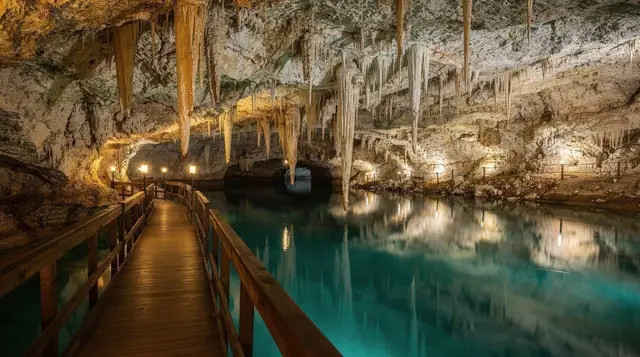
Grotta di Nettuno sits at sea level on the sheer limestone flank of Capo Caccia, the headland that closes off the bay west of Alghero, and it’s genuinely one of the more impressive show caves on the Mediterranean coast — a long chain of chambers holding a saltwater lake, stalactite columns, and a natural amphitheatre once used for local council meetings before tourism took over. Getting to it is the interesting part: there’s a road most of the way, then either 654 steps down a cliff face or a short, scenic boat ride from Alghero harbour.
| Where | Capo Caccia headland, 25 minutes’ drive or a boat trip from Alghero |
| Cave ticket | Around €13 adult, €8 child, guided tour included (Italian and English, roughly every 30-45 minutes) |
| Boat option | Add roughly €18-20 return for the boat from Alghero’s harbour |
| Steps option | Free to descend; 654 steps down and back up, no lift or shuttle |
| Season | Open year-round; boat access depends entirely on sea conditions |
By boat from Alghero
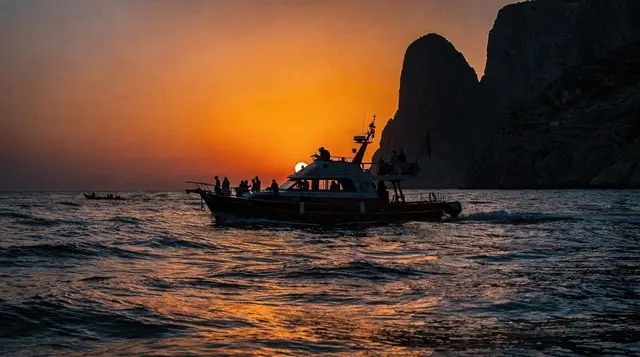
The boat option is the more relaxed way in, and the ride itself — hugging the cliffs of Capo Caccia with views back to Alghero’s old town — is part of the experience rather than a means to an end. Boats leave from Alghero’s harbour on a fixed schedule in season, dock directly below the grotto entrance, and give you a set window (usually 45-60 minutes) inside before returning. Longer catamaran itineraries combine the grotto stop with more of the Porto Conte marine park coastline, useful if you want the boat day rather than a quick there-and-back:
Six-hour catamaran tour of Porto Conte park including Capo CacciaThe catch: boats to the grotto only run when the sea is calm enough to dock safely at the cave entrance, and the stretch of coast outside Capo Caccia is exposed to the maestrale wind from the northwest. Cancellations happen with as little as a few hours’ notice in shoulder season, so if the boat is central to your plan, build in a spare day or check the forecast before committing to a specific date.
By the Escala del Cabirol
The alternative is driving to the Capo Caccia car park and descending the Escala del Cabirol (“goat’s staircase”), 654 steps cut into the cliff face, engineered in the 1950s and still the way most Sardinians visit the grotto themselves. It’s free (the cave entrance fee still applies once you’re down), always available whenever the site is open regardless of sea state, and delivers views over the cliffs and out to sea on the way down that the boat doesn’t offer.
The catch is obvious: what goes down must come back up, and 654 steps in Sardinian summer sun with no shade for most of the ascent is a genuinely hard climb, not a stroll. If you’re doing the steps, go early morning or late afternoon, carry water, and don’t underestimate how much slower the return climb feels than the descent.
Inside the grotto
Guided groups move through roughly 500 metres of the cave system, past the saltwater lake (which rises and falls with the tide, connected to the sea below), columns of stalactites and stalagmites that have fused into pillars over tens of thousands of years, and a wide chamber the local council reportedly once used for meetings before better venues existed onshore. The tour is fixed-pace and narrated, not self-guided, and the temperature inside stays a cool, constant 16-17°C whatever the weather outside — worth a light layer even on a hot day. Photography is allowed but tripods and flash setups aren’t practical given the group pace.
A brief history of the cave
Local fishermen are thought to have known of Neptune’s Grotto for centuries before it became a formal tourist attraction, but its wider fame dates to the early twentieth century, when improved access and Italy’s growing domestic tourism industry turned it into one of Sardinia’s first natural sites marketed specifically to visitors.
The Escala del Cabirol staircase was cut into the cliff face in the 1950s, replacing what had previously been a far more precarious scramble down loose rock, and it remains largely unchanged since — the same 654 steps, the same exposed drop on one side, engineered well enough that it’s still the primary access route today alongside the boat. The cave’s name comes from the Roman god of the sea, a fittingly grand label for a chamber that early visitors, without modern lighting, must have found genuinely awe-inspiring by lamplight alone.
Photography and what the tour allows
Standard photography — phones and handheld cameras — is permitted throughout the guided walk, and the combination of still water, warm lighting on the limestone formations and the sheer scale of the largest chamber makes for some of the more striking cave photographs you’ll get anywhere on the island. Tripods aren’t practical given the fixed pace of the guided group and the narrow walkways in places, and flash photography is generally discouraged near the more delicate formations, though guides rarely enforce this strictly for casual visitors. If photography is a serious priority, arriving on one of the first tours of the day, before the largest groups build up, gives more space to compose a shot without other visitors in frame.
Combining the grotto with the rest of Capo Caccia
Most visitors treat Neptune’s Grotto as the anchor of a half-day around the headland rather than the whole outing. A jeep tour covering Capo Caccia’s wider landscape — the lighthouse, the Porto Conte nature park, and viewpoints the grotto boat doesn’t reach — fills out the rest of the day for anyone without their own transport:
Nature and culture jeep tour of Capo Caccia and Porto Conte, from AlgheroFor a more independent option, renting an inflatable boat lets you explore the coastline around the headland at your own pace, though landing at the grotto itself requires the official docking arrangement rather than a private mooring:
Inflatable boat rental for exploring the Alghero coastlineAlghero and Capo Caccia boat trips covers the wider range of boat options along this stretch of coast if the grotto boat specifically doesn’t suit your dates, and day trips from Alghero has other ways to fill a full day around the headland.
The wider Porto Conte marine protected area
Neptune’s Grotto sits within the Porto Conte regional park and its adjoining marine protected area, a stretch of coastline that extends well beyond the cave itself to cover the whole Capo Caccia headland, the sheltered bay of Porto Conte, and a marine reserve with restrictions on fishing and anchoring designed to protect the same limestone cliffs and their underwater continuation.
The park’s land side is criss-crossed with walking and cycling tracks through Mediterranean scrubland and holm oak woodland, home to griffon vultures that nest on the Capo Caccia cliffs themselves — one of the few remaining breeding colonies of this bird in Italy, and worth watching for on a clear day regardless of whether you’re visiting the cave. Divers and snorkellers rate the underwater side of the reserve highly for its clarity and undisturbed marine life, covered in more detail in diving at Alghero and Capo Caccia, and it’s genuinely worth building an extra hour or two into your visit to explore the park on land rather than treating the cave as the entire reason to come out here.
Cost breakdown for a full visit
Budgeting for the whole outing rather than just the cave ticket helps avoid surprises: the cave entry itself runs roughly €13 for an adult and €8 for a child, the boat crossing (if chosen over the steps) adds around €18-20 return per person, and parking near the Capo Caccia car park, while not always formally charged, can involve a small fee in peak season at some operators’ informal arrangements.
Food and drink at the small café near the steps costs noticeably more than equivalent options in Alghero town, so many visitors either bring water and snacks or plan to eat properly once back in town. All told, a family of four doing the boat option should budget somewhere in the region of €90-120 for the full outing, less if taking the free steps route instead of the boat.
Getting there
Capo Caccia is roughly 25 minutes’ drive from central Alghero along a coastal road with limited parking near the top of the steps, busiest from mid-morning; arriving early solves most of the parking problem. If you’re relying on the boat instead, everything departs from Alghero’s harbour and no separate transport to the headland is needed.
Alghero old town and the Alghero Fertilia airport guide are useful if you’re basing your visit around the town itself, and diving at Alghero and Capo Caccia covers the same stretch of coast for anyone wanting to see the underwater side of these cliffs rather than just the cave.
Wine tasting on the way back
Anyone driving between Capo Caccia and Alghero passes close to the flat vineyard land that produces some of the north-west’s best-known wine, and it’s worth building in an hour for a tasting on the return leg rather than treating the grotto as the whole day. Cellar doors in this stretch generally pour without advance booking outside peak weekends, though calling ahead in July and August avoids arriving to a fully booked slot.
Vermentino di Sassari and Cannonau are the two worth prioritising if time only allows a short flight of two or three wines rather than a full tour, and most estates sell bottles directly at prices well below what the same label costs in a restaurant. It turns a single-attraction outing into a proper half-day loop around this corner of the coast rather than a there-and-back cave visit. See Cannonau wine guide for more on the reds grown across this part of Sardinia.
Frequently asked questions about Neptune’s Grotto
How long does a visit take?
The guided walk through the cave itself takes roughly 45 minutes. Add travel time to Capo Caccia, any queueing for tickets, and either the boat crossing or the 654-step descent and climb, for a half-day outing in total.
Is Neptune’s Grotto suitable for young children?
The cave walk itself is manageable for most children old enough to walk the distance steadily, but 654 steps each way is a serious undertaking for young legs — the boat option is the more practical choice for families with small children.
Can you book cave tickets in advance?
Tickets are generally sold on-site rather than through a fixed online booking system for the cave entry itself; the boat crossing, by contrast, is worth booking ahead in peak season since sailings can sell out.
What happens if the boat is cancelled for weather?
Operators typically offer a refund or rebooking for a different date rather than substituting the steps route automatically; check the specific operator’s policy when booking.
Is there anywhere to eat near Capo Caccia?
A small café operates near the top of the steps and around the car park; options are limited compared to Alghero itself, so many visitors eat in town before or after the visit.
How does Neptune’s Grotto compare to the caves near Cala Gonone?
Neptune’s Grotto is a single accessible show cave with a fixed guided route; Bue Marino cave near Cala Gonone is broadly comparable in scale and boat access but sits on the opposite side of the island in the Gulf of Orosei. The best caves in Sardinia compares all the island’s major show caves side by side.
Where does the cave’s name come from?
It’s named after Neptune, the Roman god of the sea, a naming convention common to several dramatic coastal caves around the Mediterranean rather than anything specific to a local legend.
Is there parking near the top of the steps?
Yes, a car park serves the Capo Caccia headland near the top of the Escala del Cabirol, though it fills quickly from mid-morning in peak season; arriving before 10am solves most of the congestion.
How busy does the cave get in summer?
Very busy by early afternoon in July and August, with guided groups running close together and queuing possible at the ticket point; the first tours of the morning, particularly via the boat’s earliest sailing, are noticeably quieter.
Is the cave floor slippery?
Some sections near the underground lake stay damp year-round, and the walkways, while maintained, can be slick in places; sturdy, closed shoes with reasonable grip are worth wearing over sandals for this reason alone.
Can I visit Neptune’s Grotto as part of a cruise stop in Alghero?
Yes — Alghero receives smaller cruise calls in season, and the grotto is a popular excursion given its proximity to the port; check sailing times against the boat schedule or the steps’ opening hours carefully if you’re on a tight return window.
Cave & canyon tours on GetYourGuide
Verified deep-linked GetYourGuide tours. Book through these links and we earn a small commission at no cost to you.
These are our own photographs of Sardinia, not the operator's pictures of this tour — open the tour page to see those.