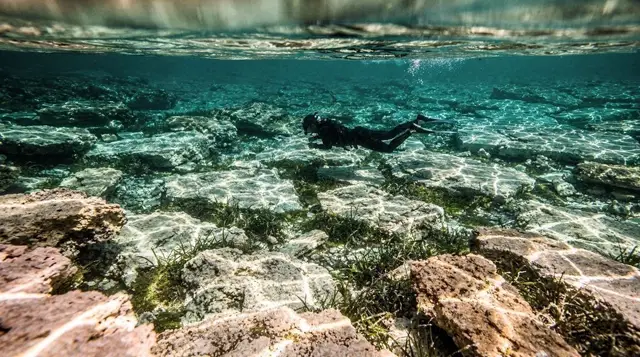
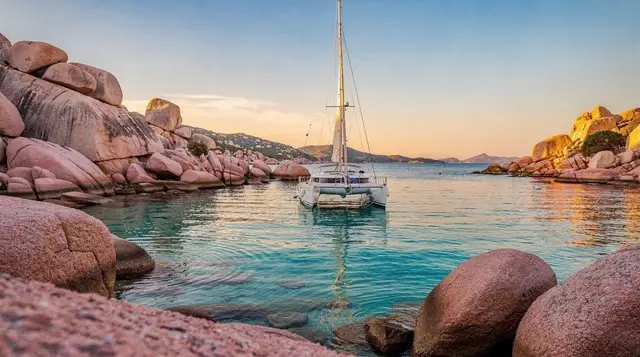
Diving at Alghero and Capo Caccia
What makes diving at Capo Caccia different from the rest of Sardinia?
Capo Caccia's limestone cliffs continue underwater as walls, swim-throughs and cave systems, including the submerged entrance to Neptune's Grotto — terrain unlike the granite drift dives of La Maddalena or the reef diving at Villasimius. It's the most technically varied diving region on the island, from gentle beginner sites to genuinely advanced cave routes.
The limestone cliffs at Capo Caccia, just outside Alghero, don’t stop at the waterline — they continue below the surface as walls, swim-throughs and cave systems, including the underwater approach to the same Neptune’s Grotto that draws visitors above the surface by boat and staircase. This makes Capo Caccia the most topographically dramatic diving region in Sardinia, and the natural first stop for anyone choosing where to dive on the island.
This guide covers the main sites around Capo Caccia, what to expect at different experience levels, prices for 2026, and how a stay in Alghero supports both diving and the rest of the town’s attractions on days you’re not underwater.
| Where | Capo Caccia headland, Porto Conte, near Alghero |
| Terrain | Limestone walls, caves, swim-throughs |
| Visibility | 15-25m typically, best June-September |
| Best for | Dramatic topography, advanced and adventurous divers |
| Season | April to November |
| Price | €50-80 per dive, €70-110 for a try-dive |
Why Capo Caccia is Sardinia’s most dramatic dive region
Unlike the granite boulder fields at La Maddalena or the reef diving at Villasimius, Capo Caccia’s limestone geology creates genuine vertical relief underwater — sheer walls dropping to real depth, narrow swim-throughs between rock formations, and cave systems including the submerged section connected to Neptune’s Grotto, the same cave system visitors reach above water by boat or the Escala del Cabirol staircase. This variety is why Capo Caccia consistently tops most divers’ shortlist when comparing Sardinia’s regions.
The Alghero diving experience covers the main sites for certified divers in a standard two-dive format, and the Capo Caccia diving trip with professional guides goes further into the more technical cave and swim-through sites, suited to divers with more experience who want the full range this coastline offers.
Beginner options: a real introduction, not a token dive
Despite the terrain’s reputation for drama, Capo Caccia also has genuinely good shallow sites suited to complete beginners. The try-dive for beginners in Alghero is a supervised, shallow introduction with an instructor, no certification required, and it still reaches interesting rocky terrain rather than a bare training pool. It’s the sensible way to find out whether diving suits you before committing to a full certification course.
Neptune’s Grotto’s underwater dimension
Most visitors to Neptune’s Grotto see it from a boat and a guided walk through the accessible chambers, but the cave system extends underwater beyond what non-divers ever see. Guided dive routes into this section are offered by some of the more specialised local operators for divers with cave or advanced certification — worth asking about specifically if this is your reason for choosing Alghero over Sardinia’s other diving regions. For the standard above-water visit, see our Neptune’s Grotto guide.
| Site type | Depth range | Suited to | Highlight |
|---|---|---|---|
| Shallow rocky coves | 5-15m | Beginners, try-dives | Gentle introduction, good visibility |
| Capo Caccia walls | 15-30m | Intermediate to advanced | Vertical relief, swim-throughs |
| Neptune’s Grotto cave sections | 10-25m | Advanced / cave-certified | Unique cave diving |
Marine life at Capo Caccia
Compared with Villasimius’s protected reserve, Capo Caccia’s marine life is somewhat less concentrated, since much of this coastline sits outside a formal marine protected area boundary in the way Capo Carbonara does. That said, divers here still regularly see groupers in the deeper rocky sections, moray eels tucked into crevices along the walls, and a healthy variety of smaller reef fish throughout the shallower sites. The Porto Conte inlet, more sheltered than the open cape itself, tends to show calmer conditions and slightly different, more sheltered-water species than the exposed cape sites further out.
Divers chasing pure marine-life density are usually better served at Villasimius or the Lavezzi Islands reserve near La Maddalena; divers chasing dramatic terrain and cave diving are better served here. It’s a genuine trade-off rather than one region being objectively superior, and it’s worth being honest with yourself about which matters more before choosing where to base a diving trip. Some divers solve this by splitting a longer Sardinia stay between two regions — a few days at Alghero for the terrain, followed by a transfer south or east to Villasimius or La Maddalena for a different style of diving — though this adds driving time that’s worth weighing against simply committing to one region and exploring it more thoroughly.
What a typical two-dive day looks like
Most Capo Caccia excursions run as a two-dive format: an early departure from Alghero’s harbour or Porto Conte, a run of 20-30 minutes to the first site, roughly 40-50 minutes underwater, then a surface interval of an hour or so back on the boat before the second, often deeper or more technical, dive. Lunch is sometimes included on longer excursions, typically a simple packed meal eaten on the boat between dives rather than a full restaurant-style service. Return to harbour is usually by early-to-mid afternoon, leaving the rest of the day free for the town itself or a rest on the beach.
Combining diving with snorkelling and the rest of Alghero
Not every day of a diving trip needs to be a dive day. The snorkelling tour along the Capo Caccia cliffs covers much of the same coastline at a shallower, more accessible level for non-diving companions or rest days between dives — see our best snorkelling spots in Sardinia guide for more shallow-water options in the area. Alghero’s old town, with its Catalan-influenced architecture and seafood restaurants, is also worth building rest days around; see our Alghero old town guide for what’s worth seeing beyond the water.
Non-diving companions can often join the boat for a Capo Caccia excursion even without diving themselves, snorkelling at the surface above the dive site or simply enjoying the coastline while the group is underwater — worth asking when booking if your group is a mix of divers and non-divers, since not every operator allows it and those that do sometimes charge a reduced non-diving passenger rate.
Costs and how to choose a dive centre
Standard single dives for certified divers run €50-80, with try-dives for beginners at €70-110 including full equipment. Several operators offer multi-dive packages that reduce the per-dive cost for anyone diving three or more times across a stay. When comparing dive centres, ask specifically about group size per dive — smaller groups get more individual attention from the divemaster, which matters more at Capo Caccia’s more technical sites than it would on a simple shallow reef dive elsewhere.
Costs and booking for 2026
Standard pricing at Alghero sits in line with the rest of Sardinia’s dive regions: €50-80 for a certified single dive including equipment, €70-110 for a try-dive or discover experience, and €350-500 for a full open-water certification course over three to four days. Some of the more technical Neptune’s Grotto cave routes command a premium above standard pricing given the specialist guiding and smaller group sizes involved — expect to pay more for these than for a standard two-dive Capo Caccia excursion.
| Experience level | What’s included | Typical price |
|---|---|---|
| Try-dive / discover dive | Instructor, shallow site, equipment | €70-110 |
| Standard certified dive | Boat, guide, equipment | €50-80 |
| Technical cave / advanced route | Specialist guide, smaller group | €90-150+ |
| Full certification course | 3-4 days, open-water qualification | €350-500 |
Book a few days ahead outside peak season; in July and August, particularly for the popular try-dive slots and the more specialised cave routes with limited daily capacity, booking a week or more ahead is the safer approach given how much demand Alghero’s dive centres see as the island’s most established diving hub.
Weather and conditions at Capo Caccia
Capo Caccia’s exposed, west-facing position means it’s directly affected by the maestrale, the north-westerly wind that’s the dominant weather feature of Sardinia’s west coast. Mornings are typically calmer than afternoons through summer, and dive centres often schedule the day’s first dive early specifically to work around this pattern. Autumn and spring can see more variable conditions, with dive schedules shifting or cancelling at shorter notice than during the more settled summer months — worth building flexibility into a diving-focused trip during shoulder season rather than booking every day rigidly in advance.
How this compares to Sardinia’s other diving regions
Capo Caccia offers the most varied terrain of the island’s three main diving regions, but less concentrated marine life than Villasimius’s protected reserve and less consistently clear water than La Maddalena’s granite channels. See our diving in Sardinia guide for the full three-way comparison, useful if you’re deciding where to base a diving-focused trip rather than assuming Alghero is automatically the right choice.
Why Alghero works well as a diving base beyond the water
Unlike some of Sardinia’s more remote diving regions, Alghero is a proper town with a genuine range of restaurants, accommodation and things to do that don’t involve the water at all, which matters on rest days or for non-diving travel companions. The old town’s Catalan heritage, a legacy of Aragonese rule dating back to the 14th century, gives Alghero a distinct character within Sardinia — separate street signage in Catalan alongside Italian, a different culinary influence than found elsewhere on the island, and an atmosphere that feels genuinely different from the rest of the coast. This makes a diving-focused stay here easier to justify to a mixed group than some of the more singularly diving-oriented bases elsewhere in Sardinia.
The airport connection also helps: Alghero-Fertilia (AHO) sits just outside town, giving direct access without the longer transfers some of the island’s other diving regions require from Cagliari or Olbia. See our Alghero-Fertilia airport guide for transfer details, and our Alghero old town guide for what to do on days you’re not underwater.
Water temperature through the season
Capo Caccia’s water temperature follows the broader Sardinian pattern: roughly 14-16°C through winter for the small minority of cold-water divers who venture out then, rising steadily through spring to reach 24-26°C at the surface by August.
Depth remains noticeably cooler than the surface even in peak summer, particularly in the deeper wall sections, so a 5mm wetsuit is the sensible standard choice across most of the diving season, with a thicker suit or semi-dry option worth considering for anyone planning multiple deep dives across consecutive days. Most rental fleets stock a range of sizes and thicknesses, but if you have a specific fit that works well for you, bringing your own remains the more comfortable option over a multi-day diving trip.
Frequently asked questions about diving at Alghero and Capo Caccia
Is Capo Caccia suitable for beginner divers?
Yes, for the shallower coastal sites — several operators run dedicated try-dives and beginner routes that stay away from the more technical wall and cave terrain.
Can I dive inside Neptune’s Grotto?
Parts of the cave system’s underwater sections are accessible to divers with the right experience level, generally advanced or cave certification, through specialised local operators; the standard tourist visit to the grotto is above water only.
What’s the visibility like at Capo Caccia?
Typically 15-25m, among the better visibility in Sardinia though slightly behind La Maddalena’s clearest channels, with the best conditions from June to September.
How does Capo Caccia compare to diving at Villasimius?
Capo Caccia has more dramatic vertical terrain — walls and caves; Villasimius’s Capo Carbonara reserve has denser marine life thanks to decades of fishing restriction. Choose based on which matters more; both suit beginners and advanced divers differently.
Do I need my own equipment?
No — all the operators referenced here include full equipment rental in their prices, standard practice across Sardinia’s dive centres.
Is there snorkelling as well as diving at Capo Caccia?
Yes, and it’s excellent — much of the coastline’s shallower terrain is genuinely good snorkelling territory even without scuba gear; see our best snorkelling spots in Sardinia guide.
What’s the best time of year to dive at Capo Caccia?
June through September for the warmest water and most reliable conditions, though April, May, October and November remain diveable with a thicker wetsuit and generally fewer other divers at the same sites.
How windy does Capo Caccia get, and does it affect diving?
The maestrale wind affects this coast directly since it faces north-west; mornings are typically calmer, and dive centres schedule around this pattern. Shoulder-season conditions can be more variable than peak summer.
Are the cave sections of Neptune’s Grotto suitable for most divers?
Only the more accessible outer sections; the deeper cave system requires advanced or cave certification. Always confirm the specific route and required qualification level before booking a cave-focused dive.
Is Alghero the best base for a first Sardinia diving trip?
It’s a strong choice thanks to the town’s infrastructure and the sheer variety of sites from beginner to advanced, though Villasimius offers gentler conditions specifically for complete beginners; see our diving in Sardinia guide for how to choose between the island’s main regions.
Diving & snorkelling tours on GetYourGuide
Verified deep-linked GetYourGuide tours. Book through these links and we earn a small commission at no cost to you.
These are our own photographs of Sardinia, not the operator's pictures of this tour — open the tour page to see those.