The Sardinian language and identity
Is Sardinian a language or a dialect of Italian?
Linguists classify sardu as a distinct Romance language, not a dialect of Italian — it split from Latin earlier than Italian did and kept features, particularly in its sound system, that Italian later lost. It exists alongside two smaller minority languages on the island, Catalan in Alghero and a form of Ligurian in Carloforte and Calasetta.
Sardinia’s sense of itself as somewhere distinct from mainland Italy runs deeper than the usual regional pride found across the country. It’s built on a language that predates Italian’s own formation, a history of long isolation that shaped everything from cuisine to festivals, and a handful of pockets on the coast where an entirely different language altogether is still spoken. None of it is packaged for tourists in any obvious way, but it explains a lot of what makes travelling around the island feel different from the mainland — and understanding even the outline of it changes how the murals, the masks and the festivals covered elsewhere on this site actually read.
| Where | Island-wide, with specific pockets in Alghero and Carloforte/Calasetta |
| Cost | Free to encounter through street signs, festivals and conversation |
| Time needed | An ongoing thread through a trip rather than a single stop |
| Getting there | Most visible in old town centres and at festival dates |
| Best time | Year-round; festival dates bring the culture most visibly to the surface |
Sardu, older than Italian in several ways
Sardu, the Sardinian language, split from spoken Latin earlier than the dialects that eventually formed standard Italian, and linguists consistently classify it as its own Romance language rather than a regional variant of Italian — a distinction UNESCO’s own classification of endangered languages also recognises.
It kept sound patterns, particularly in its vowels, that are closer to classical Latin than modern Italian’s are, which is part of why Italian speakers often find it genuinely difficult to follow rather than merely accented. It splits into two main varieties, Campidanese in the south around Cagliari and Logudorese-Nuorese in the centre and north, with real differences in vocabulary and pronunciation between the two.
Why sardu’s status has been contested
Despite the linguistic classification, sardu spent much of the 20th century treated informally as a dialect rather than a language in its own right, discouraged in schools under fascist-era Italianisation policies and, for decades after, seen by many Sardinians themselves as something to set aside in favour of standard Italian for social and economic advancement.
That view has shifted considerably in recent decades — sardu gained formal recognition as a minority language under Italian law in 1999, and Sardinia’s regional government has since run various initiatives aimed at supporting its use in schools and public life, though implementation and funding have varied considerably over the years. The result is a language with real legal standing but an uncertain practical future, caught between growing cultural pride in speaking it and the ongoing pull of Italian as the language of education, media and work.
Where the language is still alive
Sardu is spoken by a shrinking but still substantial number of islanders, more commonly among older generations and in smaller interior towns than in Cagliari or the coastal resort areas. Estimates of active speakers vary widely depending on how fluency is measured, but most linguistic surveys put meaningful daily use somewhere in the range of a few hundred thousand people, a fraction of the language’s reach a century ago, when it was the dominant everyday language across most of the island’s rural interior.
It’s most visible to visitors on road signs, which increasingly carry both Italian and Sardu place names, and at local festivals where announcements and songs are delivered in the language rather than Italian. Nuoro and the surrounding Barbagia villages, including Orgosolo and Mamoiada, are generally considered to have kept the language most actively alive in daily use.
Cagliari guided walking tourA guided walking tour through Cagliari’s old town is a good entry point for this whole subject in practice — Castello’s street signs, the accents overheard in its markets, and the guides themselves often bring up the language question unprompted when talking about the city’s own layered history.
Alguerès, Catalan on a Sardinian coast
Alghero is a linguistic island within an island — a form of Catalan, Alguerès, has been spoken here since Aragonese colonists resettled the town in the 14th century, and it survives today in street signage, some local media and among a portion of the town’s older residents. It isn’t mutually intelligible with sardu and has no real connection to it beyond both being minority languages under pressure from standard Italian. Alghero maintains active cultural ties with Catalonia itself, including exchange programmes and periodic cultural events, making it one of a small handful of places outside Catalonia where Catalan heritage is actively, rather than just historically, maintained.
Alghero historic centre walking tour with a local guideThe fuller picture of how this Catalan heritage shapes the town today, beyond just the language, is in Alghero old town guide.
Tabarchino, a third language altogether
On the far side of the island, Carloforte and Calasetta carry a third linguistic layer entirely — Tabarchino, a form of Ligurian brought by settlers resettled here in 1738 after two centuries on Tabarka, an island off Tunisia. It’s a striking example of how much can survive in isolation: a Genoese-derived dialect, kept alive on a small Sardinian island for nearly three centuries, with essentially no linguistic connection to sardu at all, and close enough to modern Ligurian that a speaker from Genoa can generally still follow it today. The fuller story is in Carloforte and its Tabarkin heritage.
Guided tour of the historic Castello district, CagliariGallurese and Sassarese, two more layers often left out
The north of the island carries two further linguistic pockets beyond the three covered above. Gallurese, spoken around Gallura’s coast and inland towns, is a Corsican-Tuscan dialect rather than a form of sardu, reflecting centuries of migration and trade across the narrow strait separating Sardinia from Corsica. Sassarese, spoken in and around Sassari, is a distinct Sardinian-Corsican-Ligurian hybrid that linguists classify separately again from both sardu and Gallurese. Neither carries the same UNESCO-level recognition as sardu, but both are further evidence of how fragmented the island’s linguistic map really is.
Cantu a tenore, identity carried in song
Alongside the spoken language, Sardinia’s traditional polyphonic singing style, cantu a tenore, carries much of the same cultural weight — a four-voice form, performed by a small group standing in a tight circle, that UNESCO recognised as Intangible Cultural Heritage in 2005. The style is closely associated with Barbagia villages, the same interior region that has kept sardu most actively alive, and the lyrics are typically sung in the language rather than Italian, tying the two traditions directly together.
Hearing it in person, usually at a local festival or a village gathering rather than a staged tourist show, is one of the more direct ways to experience the island’s identity as something lived rather than displayed. Sardinia’s other distinctive traditional instrument, the launeddas — a triple pipe played using circular breathing, unique to the island — often appears alongside it at the same events.
Identity beyond language: festivals as living history
Sardinia’s festival calendar carries as much of the island’s identity as its languages do. Sant’Efisio in Cagliari, held each May, is one of Italy’s largest religious processions and draws costumed participants from villages across the island, each wearing dress specific to their own town rather than a generic Sardinian outfit.
The Sartiglia of Oristano, a masked equestrian tournament held before Lent, and Mamoiada’s Mamuthones, covered in Mamoiada and the Mamuthones, both carry roots that most scholars trace to pre-Christian ritual rather than any Catholic origin — a reminder that the island’s identity runs back well before its more recent history as part of Italy. The full annual spread is in Sardinia festivals calendar.
The island’s three languages, side by side
Sardinia’s linguistic picture is easier to hold in mind as three genuinely separate cases rather than one general “local dialect” story.
| Sardu | Alguerès | Tabarchino | |
|---|---|---|---|
| Family | Distinct Romance language | Catalan | Ligurian |
| Where spoken | Island-wide, strongest inland | Alghero specifically | Carloforte and Calasetta |
| Arrived | Developed from Latin, pre-medieval | 14th century, Aragonese resettlement | 1738, Tabarka resettlement |
| Related to Italian? | No, separate Romance branch | No | No |
| Related to each other? | No meaningful connection between any of the three |
None of the three understand each other by default — a sardu speaker gets no real head start with Alguerès or Tabarchino, and vice versa, despite all three existing within the same small island and all facing similar pressure from standard Italian.
Political identity: autonomy and the Four Moors
Sardinia has held special autonomous region status within Italy since 1948, a recognition of its distinct history, language and geography rather than a purely administrative decision. The island’s flag, the Four Moors — four bandaged Moorish heads on a white and red cross background — predates that autonomy by centuries, tracing to medieval conflicts with North African forces, and it appears everywhere from car number plates to beach towels, a genuinely ubiquitous symbol of Sardinian rather than Italian identity.
The flag’s exact origins are debated, with competing accounts tying it to different medieval battles and periods of Aragonese rule, but its adoption as the island’s modern regional symbol is uncontested, and it’s worth noticing how consistently it appears compared with the Italian tricolour, which shows up far less in everyday Sardinian life than a visitor might expect coming from the mainland.
Identity through food, wine and murals
Even Sardinia’s food carries this same thread of separateness — Cannonau wine guide covers a grape variety some islanders argue originated here rather than in Spain, and the shepherd-based diet behind the island’s reputation as a longevity hotspot reflects centuries of pastoral isolation in the interior. Pecorino sardo, the island’s defining cheese, and pane carasau, the shepherd’s travelling bread, both grew directly out of a pastoral economy that kept much of the interior physically and culturally separate from the coast for centuries — the same isolation that helped sardu survive as a distinct language in those same villages.
The murals of Orgosolo turn identity into direct political statement, painted onto village walls rather than performed at a festival — a genuinely different, more confrontational expression of the same underlying sense of a distinct Sardinian voice, and one that speaks as much to global politics and Sardinian grievances against the Italian state as to the island’s ancient culture.
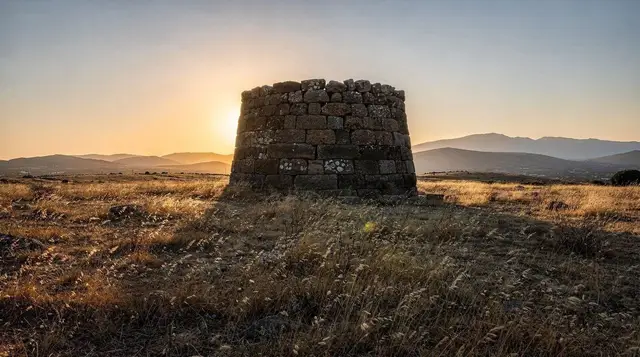
The island’s ancient roots run deeper still, back to the nuragic civilisation covered in nuraghi of Sardinia, which islanders often point to as the true starting point of a Sardinian identity that long predates Rome, let alone modern Italy. Even the word “sardo” itself carries this weight — used both for the language and, informally, as shorthand for the island’s people and character more broadly, in a way that ties linguistic and cultural identity together more tightly here than in most of Italy’s other regions.
Frequently asked questions about Sardinian language and identity
Is Sardinian a real language or just an accent?
It’s classified by linguists as a distinct Romance language, with its own grammar and vocabulary separate from Italian, not merely an accented version of it.
Do most Sardinians speak sardu today?
Fluency has declined significantly among younger generations, though it remains more widely spoken in interior towns and among older residents than on the coast.
Are Catalan and Sardinian related?
No — they’re both Romance languages but developed independently; Alguerès in Alghero has no closer relationship to sardu than Italian does.
What does the Four Moors flag represent?
A medieval symbol tracing to conflicts with North African forces, now used island-wide as the primary emblem of Sardinian identity, distinct from the Italian national flag.
Can visitors hear Sardinian spoken during a typical trip?
Yes, particularly at local markets, festivals and in smaller interior towns; coastal tourist areas tend to operate mostly in Italian.
Is Sardinia’s autonomy the same as independence?
No — Sardinia is a special autonomous region within Italy, with additional legislative powers over standard Italian regions, but it remains part of the Italian state.
How does Sardinia’s identity connect to its reputation for longevity?
The island’s Barbagia interior is one of the world’s recognised “blue zones” for exceptional longevity, a pattern researchers link partly to the same pastoral, isolated way of life that shaped the island’s language and culture more broadly.
What is cantu a tenore?
A traditional four-voice polyphonic singing style, closely tied to Barbagia villages and typically performed in sardu, recognised by UNESCO as Intangible Cultural Heritage in 2005.
Is it disrespectful to ask locals about the Sardinian independence movement?
No, though it’s worth being aware the topic ranges from mild cultural pride to genuine political conviction depending on who’s asked; most Sardinians are happy to discuss the island’s autonomy and identity when approached with genuine curiosity rather than assumption.
Does everyone in Sardinia support greater autonomy or independence?
Views vary considerably — support for full independence remains a minority position, while broader pride in Sardinian identity and support for the island’s existing autonomous status are far more widely shared.
Culture & history tours on GetYourGuide
Verified deep-linked GetYourGuide tours. Book through these links and we earn a small commission at no cost to you.
These are our own photographs of Sardinia, not the operator's pictures of this tour — open the tour page to see those.