Filigree and coral jewellery in Sardinia
Is Alghero coral jewellery genuine coral?
From an established Alghero workshop, usually yes — the city has harvested and worked red coral under regulated quotas since medieval times. Cheap "coral" from unmarked coastal stalls is frequently dyed resin or imported material; ask about provenance before buying, and expect real coral to cost noticeably more.
Alghero has worked red coral from this stretch of coast since at least the 14th century, when the city’s Catalan-Aragonese rulers established it as a trading centre for the Mediterranean coral fishery, and the craft — alongside Sardinia’s parallel filigree silverwork tradition — is still genuinely practised in workshops across the old town rather than kept alive purely for visitors. It’s also one of the easiest crafts on the island to get wrong as a buyer, since coral in particular is imitated cheaply and sold without explanation to anyone who doesn’t ask.
Alghero and the Mediterranean coral trade
Red coral (Corallium rubrum) grows slowly on rocky seabeds along parts of the Mediterranean coast, and the waters off Alghero and nearby Capo Caccia have been one of its most productive sources for centuries. Harvesting today is tightly regulated by quota to protect the reefs, which is part of why genuine coral jewellery costs what it does — the raw material itself is limited and slow-growing, not just the workmanship. A handful of workshops in Alghero’s old town still cut, polish and set coral on site, and some can show the raw, unworked material alongside finished pieces so you can see the process end to end.
a guided walk through Alghero’s historic centre passes several of these working coral studios in the lanes near the cathedral, a good way to see genuine workshops rather than just the shopfronts facing the main tourist streets.
What genuine coral actually costs
A small pendant or pair of earrings in genuine, well-cut coral typically starts around €30-60; larger pieces, deeper red tones (considered the finest grade), and more elaborate silver or gold settings push well past €200-500. Colour and clarity matter as much as size — the deepest, most uniform red (“sangue di bue”, ox-blood red) commands the highest prices, while paler pink or mottled pieces cost considerably less for a similar size. If a piece described as coral costs a few euros for a substantial necklace, it almost certainly isn’t coral — dyed resin, glass or reconstituted coral powder are common substitutes sold without clear labelling on stalls outside the established workshops.
Filigree: the parallel silver tradition
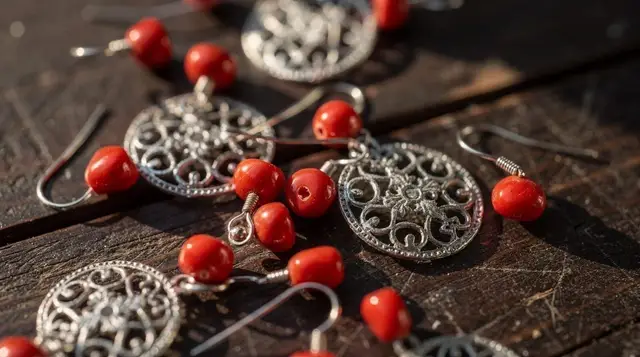
Alongside coral, Sardinia’s filigree silverwork — fine wire twisted and soldered into lace-like patterns — has its own centres in Alghero, Cagliari and Bosa, and the two crafts are often sold side by side, sometimes combined in the same piece (coral set within a filigree frame is a classic local design). The signature filigree object is the fede sarda, a traditional betrothal ring made from two interlocking woven bands, though the technique also produces earrings, brooches and the ornamental buttons used on traditional Sardinian dress.
Genuine hand-soldered filigree has visible depth and slightly uneven texture under close inspection; machine-stamped imitation pieces, common in souvenir shops, look flatter and more uniform. See Sardinian crafts and what to bring home for how filigree compares with the island’s other craft traditions.
a walking tour of Alghero’s ancient city walls is worth combining with time spent browsing the jewellery quarter, since the same old-town lanes hold both the historic sites and the working studios.
Where to buy, and what to ask
The safest approach in Alghero is to buy from an established workshop with visible signage indicating it’s a working studio rather than a general souvenir stall — ask directly whether coral is sourced under regulated Mediterranean harvest, and a genuine workshop will usually be happy to explain provenance in some detail, since it’s part of what justifies the price. For filigree, ask whether a piece is hand-soldered; a workshop proud of the technique will generally show or explain the process without hesitation. If a shop can’t or won’t answer either question clearly, treat that as a signal to look elsewhere.
a private 2.5-hour walking tour of Alghero can be arranged with a focus on the jewellery quarter and coral history specifically if that’s the main reason for the visit — worth requesting when booking.
How filigree is actually made
Genuine filigree begins with fine silver (or occasionally gold) wire, drawn down to a thickness comparable to thick thread, then twisted, coiled and soldered by hand into repeating geometric and floral patterns — a technique that requires years of practice to execute at the level seen in the best workshop pieces.
Traditional Sardinian filigree favours dense, symmetrical designs built from small coiled units repeated across a larger form, distinct in style from lighter, more open Genoese or Neapolitan filigree traditions found elsewhere in Italy. The finished piece is typically given a light polish rather than heavy plating, which is part of why genuine filigree develops a soft patina over years of wear rather than staying artificially bright — something worth knowing so you don’t mistake natural ageing for lower quality.
Regulation and sustainability of the coral harvest
Mediterranean red coral has been fished commercially for centuries, and overharvesting in the 20th century led to tighter regulation across the region, including quotas, minimum size limits on harvested coral, and depth restrictions intended to protect the slower-growing deep colonies. Sardinia’s coral fishery today operates under this regulated framework, and established Alghero workshops sourcing through licensed channels can generally explain, at least in outline, how their material was harvested. This is worth asking about specifically if sustainability matters to you as a buyer — it’s also one more reason genuine coral costs meaningfully more than imitation material, since the regulated supply is deliberately limited.
Gift pieces versus investment pieces
Not every visitor needs to leave with a major purchase. A small filigree charm or a modest coral stud, both achievable for well under €100, make genuinely distinctive gifts without requiring the same scrutiny of provenance that a major piece deserves. For anyone treating a purchase as closer to a lasting investment — a large coral pendant, an elaborate filigree necklace, or a fede sarda wedding ring — it’s worth visiting two or three workshops before committing, comparing not just price but the depth and evenness of the metalwork or the clarity and colour consistency of the coral, since genuine variation in quality exists even among legitimate workshops.
Combining jewellery shopping with sightseeing
Alghero’s jewellery quarter sits within the same compact old town as the city’s main historic sights, so a shopping-focused morning or afternoon slots naturally alongside visiting the cathedral, walking the Bastioni ramparts, or a boat trip out toward Capo Caccia. Many visitors save jewellery browsing for an early evening after a day on the water, when the old town’s lanes are at their most atmospheric and workshops are open for the evening passeggiata crowd. See Alghero old town guide for a fuller walking route that takes in both the historic sights and the craft quarter in a single loop.
A short history of Alghero’s coral trade
Alghero’s coral industry dates to the city’s Catalan-Aragonese period from the 14th century onward, when Barcelona-based merchants recognised the value of the coral beds off this stretch of coast and established the city as a processing and trading centre for the wider Mediterranean market. For several centuries, coral was one of Alghero’s most valuable exports, worked locally by specialist artisans and shipped onward through Mediterranean trade networks that reached as far as North Africa and the Middle East, where red coral held (and in some cases still holds) significant cultural and decorative value.
The industry declined through the 19th and 20th centuries as overharvesting depleted accessible reefs and synthetic alternatives reduced demand for genuine coral more broadly, but the specific craft skills survived in a handful of Alghero workshops that continued working smaller, sustainably regulated quantities of coral into the present day — the same workshops, broadly, that a visitor browsing the old town today is likely to encounter.
Caring for coral and filigree jewellery
Coral is a soft, organic material — avoid perfumes, hairspray and swimming pool chlorine, all of which can dull its colour over time, and store pieces separately from harder stones that could scratch the surface. Filigree, being fine worked silver, tarnishes like any silver jewellery; a soft polishing cloth kept for the purpose is enough for occasional cleaning, and pieces are best stored in a fabric pouch rather than loose in a bag, since the fine wirework can catch and bend against other jewellery.
Filigree and coral as part of traditional dress
Both crafts have a role beyond individual jewellery pieces: filigree buttons, brooches and pendants are integral parts of traditional Sardinian women’s costume, worn during festivals like Sant’Efisio and Redentore, where the specific style and quantity of filigree worn historically signalled a family’s status within a village.
Coral, similarly, appears in older traditional jewellery sets, particularly in coastal areas with closer historical ties to the Mediterranean coral trade. Seeing these pieces worn in context at a festival, rather than only in a shop window, gives a different appreciation for the craft than browsing alone — worth timing a visit around if your trip allows for it.
Comparing Alghero with Cagliari and Bosa for jewellery shopping
If your itinerary includes more than one of Sardinia’s filigree centres, each has a slightly different character worth knowing about. Alghero’s specific strength, as covered throughout this guide, is the combination of coral and filigree together, tied to its unique medieval trading history. Cagliari’s filigree scene, concentrated in the Marina and Castello quarters, tends toward a wider range of price points and styles, reflecting the larger city’s bigger and more varied customer base. Bosa’s smaller-scale filigree workshops, clustered around the town’s colourful riverside houses, are worth a stop if your route already includes the west coast, offering a quieter, less crowded browsing experience than either Alghero or Cagliari.
Buying jewellery as a gift versus for yourself
Choosing a piece to give as a gift changes the calculation slightly from buying for yourself. A smaller filigree piece, or a modest coral pendant with a clear, simple design, tends to travel better as a gift than an elaborate statement piece whose style might not suit the recipient’s taste. If you’re unsure of a recipient’s preferences, classic designs — a simple fede sarda-style ring for a couple, or plain coral studs — are safer choices than the more elaborate, ornate pieces some workshops specialise in, which suit a buyer choosing specifically for themselves after seeing the full range in person.
When to shop: avoiding the busiest hours
Alghero’s old town jewellery quarter is busiest in the late morning and early evening, when cruise passengers and day-trippers from elsewhere on the coast concentrate their browsing time. Visiting a workshop earlier in the morning, shortly after opening, generally means more attentive service and a better chance to ask detailed questions about provenance and technique without competing for a shopkeeper’s attention. If your schedule allows it, this is also often the most pleasant time to walk the old town generally, before the day’s heat and crowds build.
Frequently asked questions about Alghero coral and filigree
Is it legal to buy and export coral jewellery from Sardinia?
Yes, coral sold by licensed workshops through the regulated Mediterranean fishery is legal to buy and take home; it’s the unregulated harvest and trade that’s restricted, not the finished retail product from an established seller.
How can I tell real coral from imitation?
Genuine coral has a slightly cool, dense weight and subtle natural variation in tone; dyed resin or glass tends to feel lighter and look unnaturally uniform in colour. When in doubt, buy from a named workshop that can explain the material’s origin.
Is filigree jewellery only made in Alghero?
No — Cagliari and Bosa both have long-standing filigree traditions too; Alghero’s specific strength is the combination of filigree with locally worked coral.
What’s the price range for a genuine coral necklace?
Roughly €100 upward for a modest necklace, rising well past €500 for larger pieces in deep red coral with an elaborate setting.
Can I see coral being worked in Alghero?
Some workshops in the old town do craft visible work on site or can explain and show the process on request — worth asking when browsing rather than assuming it’s not possible.
Is Alghero the best place in Sardinia to buy jewellery?
For coral specifically, yes — it’s the island’s historic centre for the craft. For filigree alone, Cagliari and Bosa are equally strong options if your itinerary takes you there instead.
How is Sardinian filigree different from filigree made elsewhere in Italy?
Sardinian filigree tends toward denser, more symmetrical repeating patterns compared with the lighter, more open styles found in Genoese or Neapolitan filigree traditions, giving pieces a heavier, more three-dimensional look.
Does coral jewellery need any special care beyond avoiding perfume and chlorine?
Store it away from harder stones that could scratch its surface, and avoid dropping it — coral is more brittle than metal jewellery and can chip on impact.
Is it worth buying jewellery early in a Sardinia trip or waiting until the end?
Waiting until later in the trip, once you’ve seen a few workshops for comparison, generally leads to a better-informed purchase than buying on day one from the first shop you pass.
Shopping & craft tours on GetYourGuide
Verified deep-linked GetYourGuide tours. Book through these links and we earn a small commission at no cost to you.
These are our own photographs of Sardinia, not the operator's pictures of this tour — open the tour page to see those.